
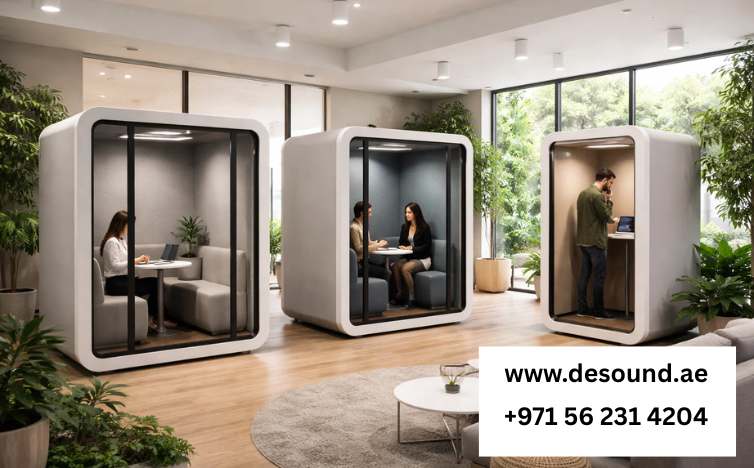
The acoustic pod market has exploded. Walk into any commercial fit-out showroom in Dubai, browse any regional procurement platform, and you’ll find dozens of options — different sizes, different price points, different brands making broadly similar claims about isolation performance and interior comfort. Single-person phone booths. Four-person meeting pods. Focus rooms with integrated tech. All of them marketed with STC ratings and NRC values and phrases like “professional-grade soundproofing.”
Some of them deliver. Some of them don’t. And the gap between a pod that genuinely works and one that looks like it should work is significant enough — in daily usability, in occupant comfort, and in how the investment ultimately serves the business — that buying the wrong one is a mistake worth avoiding with a few hours of proper research.
This is that research, compressed.
The STC Number Doesn’t Tell the Whole Story
Every acoustic pod manufacturer leads with an STC rating. Sound Transmission Class — the industry-standard measure of how much airborne sound a structure blocks. A pod rated STC 35 blocks 35 decibels of sound. STC 45 blocks 45 decibels. The higher the number, the more isolation the pod provides. Simple enough.
Except the number is only as useful as the conditions under which it was measured. STC ratings are typically measured in controlled laboratory conditions — panels tested in isolation, without the seams, joints, ventilation penetrations, cable management openings, and door gap realities that characterise an assembled pod in actual use. The assembled pod almost always performs below its laboratory-rated panel specification. The question is by how much — and that depends entirely on how well the manufacturer has addressed the assembly details.
The gaps and seams between panels, the door seal quality, the acoustic treatment around ventilation penetrations — these are where pod performance lives or dies in practice. A pod with STC 40 panels and excellent assembly detail will outperform a pod with STC 45 panels and compromised door seals every time. Ask suppliers specifically how the pod has been tested: panel-only or fully assembled. Ask for real-world case studies from installations in environments comparable to yours. The answer to these questions tells you more about actual performance than the headline STC number alone.
Ventilation Is the Feature Most Buyers Underestimate
This is the pod buying mistake that costs companies money and occupant wellbeing simultaneously — and it’s consistently underweighted in purchase decisions because it’s less visible than the acoustic specification.
A sealed acoustic pod without adequate ventilation becomes uncomfortable within minutes of occupation. CO2 levels rise as the occupant breathes in the sealed space. Temperature increases from body heat and electronic equipment. The occupant starts feeling stuffy, then warm, then unable to concentrate — which defeats the entire purpose of the pod. In Dubai’s ambient temperatures, where the air-conditioned office environment the pod sits in may itself be running at 22 to 24°C, a pod without proper ventilation is consistently reported as physically uncomfortable after 10 to 15 minutes of occupation.
The ventilation system needs to do something acoustically difficult: move enough air to maintain comfortable CO2 levels and temperature, while not creating a noise transmission path through the ventilation penetration that undermines the pod’s acoustic isolation. Good pods solve this through either passive acoustic labyrinth ventilation systems — air paths that turn multiple times to prevent direct sound transmission — or through low-noise active ventilation fans with acoustic lining in the duct path. Ask specifically about the ventilation approach and, if possible, sit in the pod for 20 minutes during any demonstration or showroom visit. If it’s uncomfortable after 20 minutes, it will be unusable after 30.
Door Seals — The Most Critical Assembly Detail
The door of an acoustic pod is the single most performance-determining component in the entire structure. It’s also the component that degrades fastest under daily use and the one that most distinguishes a well-engineered pod from a cheaper alternative that looks similar from the outside.
A pod door needs to close completely and create an acoustic seal at every contact point — the perimeter of the door against the frame on all four sides, and the threshold at the bottom. This requires compression seals that engage positively when the door closes, creating continuous contact without gaps. The door itself needs sufficient mass to contribute meaningfully to the pod’s total transmission loss — a lightweight hollow door with good seals will outperform a heavy door with poor seals, but a heavy door with good seals is the specification that serious pod manufacturers target.
The practical test during any pod evaluation is simple: close the door and tap rhythmically on the outside panel while someone listens inside. Then open the door slightly — just a millimetre — and repeat. The difference in what the person inside hears represents the seal contribution to the pod’s total performance. If the sound level inside with the door fully closed is barely lower than with it open a crack, the door seal is inadequate. This test takes 30 seconds and tells you more about real-world pod performance than any specification sheet.
Interior Acoustic Treatment — What’s Inside Matters as Much as What’s Blocked
Acoustic isolation — keeping outside sound out — is half the pod’s job. The other half is ensuring that conversations inside the pod don’t reverberate, echo, or feel acoustically uncomfortable for the occupant. A pod that’s well-isolated but untreated internally creates a small, hard-surfaced echo chamber. Voice recordings on calls sound boxy and unprofessional. Extended occupation feels fatiguing because the reflective internal acoustic adds cognitive load to every conversation.
Interior treatment should cover all internal wall surfaces with absorptive material — typically high-density foam or PET panels — in sufficient coverage to bring the pod’s internal reverberation time below 0.4 seconds. For a phone booth sized pod, this is achievable with full-coverage wall treatment. For larger multi-person meeting pods, ceiling treatment becomes equally important because the flat ceiling surface is a primary reflection point for conversation in seated groups.
Check whether the internal panel coverage is genuine absorption with measurable NRC performance or decorative felt with minimal acoustic function. Some manufacturers apply thin fabric-covered foam that looks acoustically intentional but achieves NRC below 0.3 — inadequate for the small enclosed volume of a pod where every surface matters significantly more than in a larger room. Ask for the NRC rating of the internal panels specifically, and look for values above 0.7 for a pod that will feel acoustically comfortable rather than acoustically claustrophobic.
Size and Configuration — Getting This Wrong Is Expensive
Dubai’s commercial market has converged on a few standard pod categories: the single-person phone booth designed for calls, the two-person focus pod for individual work or one-on-one conversations, and the four-person meeting pod for small group discussions. Each has different spatial requirements, different ventilation demands, different furniture configurations, and different minimum footprint requirements for the office space they’ll occupy.
Getting the size wrong in either direction creates problems. Too small and the pod becomes a point of conflict — valuable limited capacity, occupants feeling physically cramped, and the pod serving the narrow use case of very short calls rather than the diverse quiet-work needs of a modern Dubai office. Too large and the pod consumes valuable office floor area, costs more to purchase and more to condition, and may feel awkwardly underoccupied for its primary single-person use case.
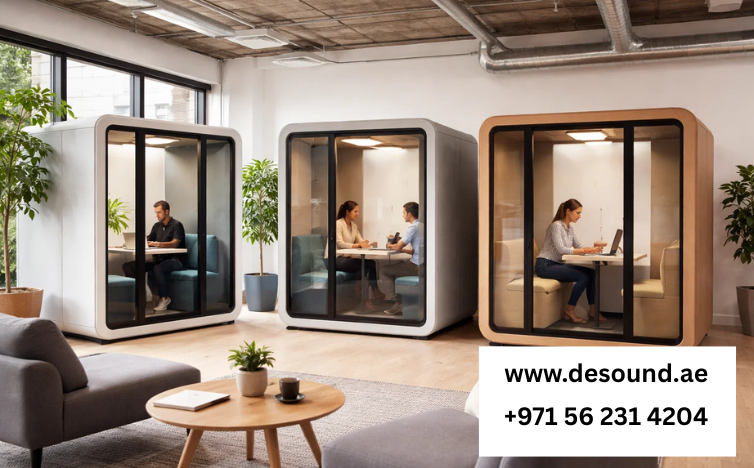
The right sizing decision starts with an honest audit of how the pod will actually be used. If the primary use case is solo phone calls and video meetings averaging 20 to 30 minutes, a single-person booth is correct and larger options waste money and space. If the team needs focused project work sessions of one to two hours alongside call capability, a two-person configuration provides the spatial comfort that makes extended occupation viable. For meeting and collaborative discussion, the four-person configuration needs to provide enough circulation space that occupants don’t feel physically constrained — pods that nominally seat four but only work comfortably with three are a false economy.
The Dubai Climate Consideration Buyers Routinely Miss
A pod in Dubai sits inside an air-conditioned commercial space — so the external climate seems irrelevant. It’s not, for two specific reasons.
The pod’s internal temperature management depends on the ambient temperature of the space it occupies. If the office runs at 22°C and the pod’s ventilation system is specified for a European office environment running at 20°C, the pod will run warmer than its design intent in Dubai conditions. This matters most for extended occupation — the 45-minute meeting, the two-hour focus session — where occupant comfort directly determines whether the pod gets used or avoided.
The materials inside the pod matter for the Gulf environment too. Adhesive-bonded internal panels in pods from manufacturers not familiar with Gulf climate conditions can delaminate as the pod’s internal temperature cycles. Pods that sit next to windows with direct solar gain are particularly vulnerable to this — the pod exterior can reach temperatures significantly above the ambient office temperature when sun-exposed. Confirm with any pod supplier that the materials and adhesives used in the pod’s construction are rated for the temperature range the pod will actually experience in its Dubai installation location.
The Integration Questions Worth Asking Before Purchase
The pod doesn’t exist in isolation — it needs to work within the office environment it’s placed in, and the integration details determine how smoothly it functions in daily use.
Power and data connectivity matters immediately. A pod without adequate power outlets and reliable wired or wireless data connectivity is a productivity constraint rather than a productivity tool. Check the number and position of power outlets, whether USB-A and USB-C charging points are included, and how the pod connects to the office network — whether through a physical cable that runs discreetly under the floor or through a wireless solution that relies on the building’s existing WiFi coverage.
Lighting is undervalued in pod specifications. The video call is the primary use case for most Dubai office pods. The lighting in the pod determines the quality of the occupant’s video presence — which is a business communication consideration in any professional context. A pod with harsh overhead lighting or inadequate brightness creates unflattering video output that no amount of software background enhancement fixes. Ask specifically about the lighting type, colour temperature, and whether it’s adjustable — because a pod that makes occupants look good on camera is a pod they’ll actually want to use.
De Sound’s acoustic pod services in Dubai cover specification, supply, and installation — including the assessment of where in the office the pod should be positioned for both acoustic and practical effectiveness. For businesses in Dubai making this investment, that integrated support ensures the pod performs as expected from day one rather than creating unexpected integration problems that erode the value of the purchase.
Call us: Contact DeSound Soundproofing Expert in Dubai For Soundproofing: +971 56 231 4204
The Question That Simplifies the Entire Decision
After all the specifications, STC numbers, ventilation ratings, and interior panel NRC values — the most reliable way to evaluate any acoustic pod before buying it is to use it.
Sit in it for 20 minutes. Make a call. Have a colleague stand outside and speak at normal volume. Close your eyes and notice whether the interior acoustic feels comfortable or claustrophobic. Notice whether the ventilation is audible and whether it’s creating its own noise problem. Notice whether the temperature is rising. Notice whether the door closes solidly or with any compromise.