
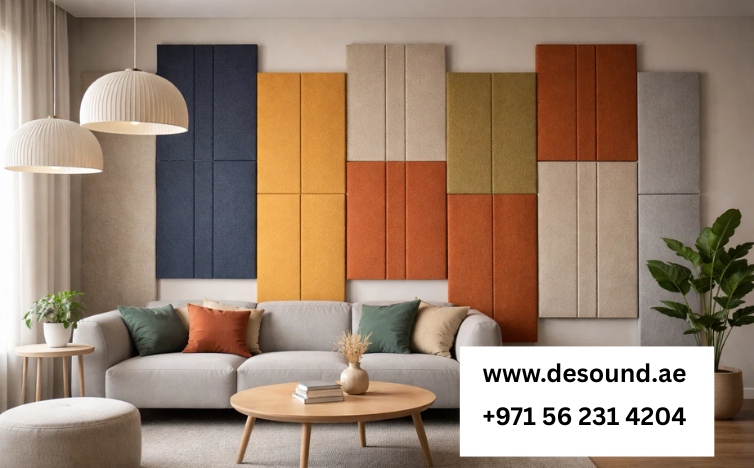
The question gets asked regularly and the answers online are almost universally unhelpful. “Both are great options.” “It depends on your project.” “Each has unique benefits.” None of this tells anyone anything they can act on.
So let’s be direct. PET panels and acoustic fabric are not the same product in different forms. They’re not even really competitors for the same specification slot in most projects. They do different things, serve different functions in an acoustic treatment system, and choosing between them without understanding that distinction leads to buying the wrong material for the job — then wondering why the result doesn’t perform as expected.
Here’s what actually separates them.
What Each One Actually Is
PET acoustic panels are rigid, self-supporting boards made from 100% recycled polyester fibre — the same base material as PET plastic bottles, compressed and bonded into a dense panel. They arrive as finished products. Mount them to a wall, and they absorb sound. The panel itself is both the structural element and the acoustic element simultaneously. De Sound’s PET panels achieve NRC ratings up to 0.9, available at AED 160 to 250 per panel depending on size and thickness.
Acoustic fabric is a material component — not a finished panel. It’s a breathable woven textile, typically 100% taslanized polypropylene or polyester, engineered specifically to allow sound waves to pass through it into an absorptive core behind rather than reflecting them off the surface. De Sound’s acoustic fabric is priced at AED 35 per square metre and is used as the facing material in stretch fabric wall track systems — where it’s tensioned over an absorptive backing material within a perimeter track to create wall or ceiling coverage.
One is a complete product. One is a component of a system. This distinction is the key to understanding when each one is the right choice.
The Performance Comparison — Where the Numbers Actually Sit
PET panels at 12mm thickness achieve NRC ratings in the range of 0.7 to 0.9 depending on the frequency range being measured and the mounting conditions. At 25mm thickness, performance at lower frequencies improves meaningfully. The absorption is inherent to the PET fibre core — the material itself is the acoustic element.
Acoustic fabric alone has minimal acoustic performance. Its flow resistivity — the property that determines how much sound energy it absorbs — is too low for significant independent absorption. The fabric’s acoustic contribution is almost entirely in how it allows sound to pass through to the absorptive backing rather than reflecting it. The total acoustic performance of a stretch fabric system depends on what’s behind the fabric, not the fabric itself.
This means direct NRC comparison between the two products is not a meaningful exercise. The relevant comparison is between a PET panel installation and a complete stretch fabric wall system — panel plus track plus absorptive backing. When a stretch fabric system is properly specified with appropriate backing material, it can achieve NRC performance comparable to or exceeding standalone PET panels. When the backing is inadequate or absent, the fabric facing delivers almost nothing acoustically despite looking like treatment.
The Design Flexibility Gap Between Them
This is where the two products diverge most significantly in practical application — and where the choice for many projects becomes obvious.
PET panels come in fixed panel sizes and a defined range of colours and surface treatments. De Sound’s PET panel range offers multiple colour options and can be CNC-cut into custom shapes. This flexibility is real and valuable. But each panel has visible edges, visible panel-to-panel joints at large coverage areas, and a scale defined by the panel dimensions. The installation has a characteristic visual rhythm — the grid or pattern of discrete panels — that reads clearly as a surface treatment applied to the wall.
Acoustic fabric in a stretch track system covers wall or ceiling areas in a single continuous surface. No visible panel joints. No grid pattern. No visible acoustic treatment aesthetic at all — just a fabric-covered surface that can run from floor to ceiling, around corners, across irregular wall geometries, and over ceiling soffits in a single seamless installation. The visual result is a premium, tailored surface that reads as an intentional interior finish rather than applied acoustic treatment.
For projects where the acoustic treatment needs to be invisible — luxury hospitality, branded corporate environments, premium residential interiors — the stretch fabric system’s seamless coverage is a capability PET panels simply cannot match regardless of their acoustic performance. The fabric surface is also endlessly customisable: De Sound’s acoustic fabric range covers multiple shades and can be specified to match any interior palette with precise colour references.
Where PET Panels Win Decisively
Directness and value. PET panels are the faster, simpler, more cost-effective treatment solution for the majority of acoustic treatment projects that don’t have premium aesthetic requirements.
A Sharjah office needing conference room treatment. A Dubai home studio needing wall absorption. A school classroom needing reverberation control. A gym or sports facility needing ceiling and wall treatment across large areas. In all of these contexts, PET panels deliver excellent acoustic performance, install directly to any surface, require no track system or specialist installation, and produce a clean, professional result at significantly lower total cost than an equivalent stretch fabric system.
The durability argument also favours PET for high-traffic environments. The rigid PET panel surface resists impact, can be cleaned, and doesn’t show contact damage the way stretched fabric can. In corridors, classrooms, and sports facilities where surface contact is a regular occurrence, PET panels handle daily institutional use without requiring the care that fabric surfaces need.
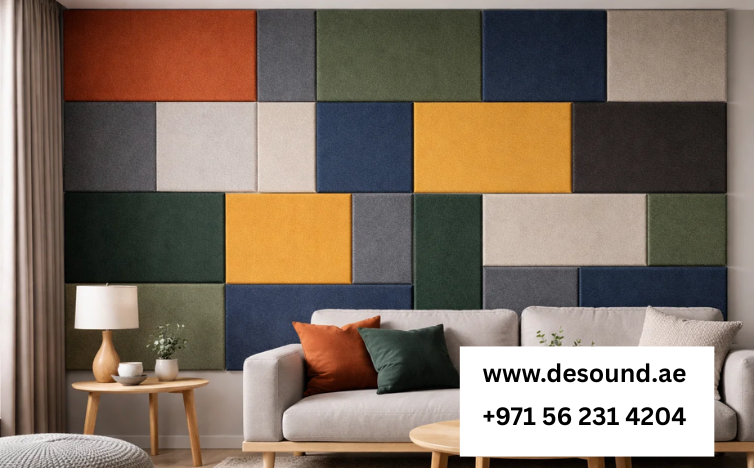
The eco-credentials of PET panels are also worth noting — made from 100% recycled polyester, they represent a genuinely sustainable material choice with documented environmental credentials. For projects with green building certification requirements or sustainability-focused procurement policies, this is a specification advantage that acoustic fabric systems don’t consistently match.
Where Stretch Fabric Wins Decisively
Any project where the visual outcome matters as much as the acoustic outcome — which in Dubai’s commercial market is a significant proportion of all specification decisions.
Hospitality fit-outs where the interior language is premium and the acoustic treatment needs to disappear into the design. Corporate headquarters where brand colours need to be expressed through wall surfaces. High-end residential spaces where a fabric-covered wall reads as considered luxury rather than acoustic infrastructure. Conference rooms in financial and legal services environments where the client-facing space must communicate professionalism at every visual detail.
The stretch fabric system also wins where wall geometry is irregular — curved walls, angled ceiling soffits, columns, or any architectural form that doesn’t suit the rectangular format of discrete panels. The track system follows any profile, and the fabric stretches to accommodate complex forms that panels cannot cover cleanly.
For very large wall areas where panel-to-panel joints would be visually dominant, stretch fabric coverage eliminates this problem entirely. A boardroom with 6-metre-high walls treated with a seamless stretch fabric system looks architecturally resolved. The same wall treated with panels, however well-installed, has visible joints that interrupt the surface.
The Cost Reality — What Each System Actually Costs to Implement
At the material level, the comparison looks simple: acoustic fabric at AED 35 per square metre versus PET panels at AED 160 to 250 per panel. PET panels appear significantly more expensive per unit.
The full-system cost comparison looks different. A stretch fabric wall system requires the perimeter track, the backing material behind the fabric, the fabric itself, and the installation labour of a track system specialist. When all components are accounted for, a properly specified stretch fabric wall system costs more per installed square metre than a PET panel installation in most configurations.
For budget-constrained projects, PET panels are the value choice without meaningful acoustic performance compromise. For projects where the installation quality and visual outcome justify a higher specification budget, the stretch fabric system delivers a result that PET panels cannot achieve regardless of how well they’re installed.
Call us: Contact DeSound Soundproofing Expert in Dubai For Soundproofing: +971 56 231 4204
The Projects That Use Both — Because Most Serious Acoustic Specifications Do
The framing of PET versus acoustic fabric as competing options obscures the way they’re most effectively used in practice: together, in the same project, with each material doing what it does best in different areas of the space.
A common and well-resolved specification pattern in Dubai commercial fit-outs uses PET panels in back-of-house areas — server rooms, recording booths, equipment spaces — where acoustic performance is the only criterion. Stretch fabric panels appear in client-facing areas — reception, boardrooms, lobby spaces — where the visual quality of the acoustic treatment is as important as the acoustic performance itself. The project benefits from the economy of PET where the surface isn’t on display and from the premium finish of stretch fabric where it is.