
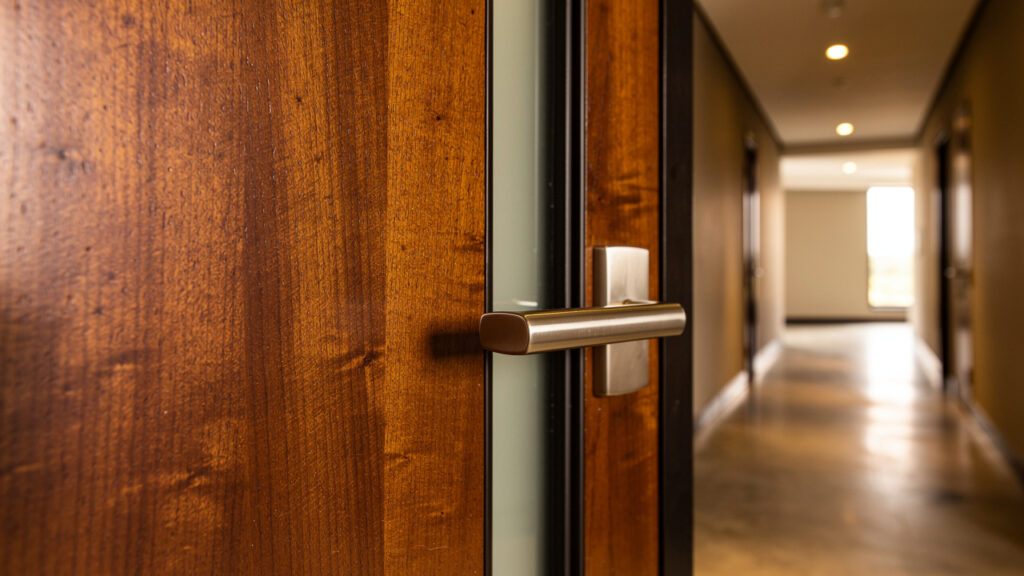
Wooden acoustic doors are purpose-built timber door systems that block sound, not just decorate an opening. In African commercial buildings, they replace light, hollow doors that let traffic, voices, and music leak between rooms. These acoustic timber doors use heavy layered cores and tight seals to turn noisy spaces into calmer, more private zones.
Growing African cities bring busy streets, dense offices, and active hospitality corridors. That extra noise hides in meeting recordings, disturbs guests, and distracts staff.
This article explains what these doors are, how STC and Rw ratings work, where they fit best in African projects, and what matters most when specifying them. It also shows how a supplier like DE Sound reduces risk with tested products and technical support. The goal is simple: a clear guide that helps project teams avoid underperforming doors.
Ready to look at the key points that drive good acoustic door choices in Africa?
Key Takeaways
A few core ideas help commercial teams use wooden acoustic doors effectively in African projects. These points give a quick mental checklist before any detailed specification. They also show where most acoustic door failures start.
Wooden acoustic doors are not standard doors. They use dense layered cores, heavy frames, and tested seals. A normal hollow door mostly blocks sight, not sound. In a hotel or office, that gap between visual privacy and acoustic privacy hurts comfort, focus, and confidentiality.
STC and Rw ratings are the main performance numbers. They tell you how much sound a full door assembly blocks in a lab test. Lower ratings still allow clear speech to pass, while higher ratings turn loud talk into a faint murmur. Matching the rating to the space type is the only way to avoid paying for performance you do not need or, worse, falling short.
Seals matter as much as the door leaf. Perimeter seals and automatic drop seals are as important as the door leaf itself. A 3‑millimeter gap can drop performance from high grade to average. Correct frames, thresholds, and installation keep the actual result close to the lab rating.
Different building types need different ratings. The strongest demand for wooden acoustic doors in Africa comes from offices, hotels, schools, healthcare buildings, and content creation spaces. Each sector has its own STC range, finish preferences, and fire rating needs. Knowing that pattern makes project planning much easier.
Supplier choice affects risk. Choosing a supplier is about more than price. Independent test data, dual fire and acoustic certification, help with detail drawings, and realistic lead times are all non‑negotiable. DE Sound positions itself on exactly these points, supported by wholesale pricing and technical advice.
What Are Wooden Acoustic Doors And Why Do Commercial Buildings In Africa Need Them?

Wooden acoustic doors for African commercial buildings are engineered timber doors that block airborne sound while still matching interior design. They replace lightweight internal doors that only offer visual separation. For architects and contractors, they act as one of the main building blocks of a serious acoustic strategy.
Instead of a single thin board, these doors use layered cores built from materials such as high‑density particleboard, MDF, and sometimes mineral infill, a principle supported by research on the Application of Hybrid Absorptive–Diffusive panels that demonstrates how layered wooden overlays achieve variable acoustic characteristics. Extra mass helps because of the mass law: the heavier the leaf, the harder it is for sound vibrations to pass through. Around the leaf, purpose‑designed frames and compression seals close off gaps that would otherwise leak sound.
Standard hollow core doors often reach only around STC 17 to 20 in lab tests, according to data summarized by the National Research Council Canada. That level barely slows normal speech. In contrast, well‑designed wooden acoustic doors for offices, hotels, and schools commonly target STC values in the high 30s or 40s, with studio doors going even higher.
African cities such as Lagos, Nairobi, Johannesburg, and Accra are urbanizing quickly. Projections from the United Nations Department of Economic and Social Affairs indicate that Africa’s urban population will at least double within a few decades. More people in dense areas means more traffic noise, more mixed‑use buildings, and more stacked functions inside the same structure.
That density turns noise into a health and comfort issue. The World Health Organization notes that environmental noise contributes to sleep disturbance and even cardiovascular problems, with one report estimating over one million healthy life years lost each year in Western Europe alone. In that context, well‑specified acoustic doors stop being a luxury add‑on for African commercial buildings. They become part of good building practice for offices, hotels, hospitals, and learning spaces.
For fit‑out contractors and facility managers, the takeaway is clear: if a project brief mentions privacy, focus, guest comfort, or sensitive conversations, wooden acoustic doors should appear in the specification, not as an afterthought but as a planned line item.
How Is Acoustic Performance Measured? Understanding STC And Rw Ratings

Acoustic performance for wooden acoustic doors is measured using STC and Rw ratings that describe how much sound passes through a tested assembly. These single numbers help designers compare products and match them to project needs. Without them, acoustic specification quickly becomes guesswork.
STC, or Sound Transmission Class, comes from North American standards such as ASTM E90. Rw, the weighted sound reduction index, follows ISO testing methods often used in Europe and South Africa. For most commercial doors, STC and Rw values are usually very close, so many project teams treat them as approximate equivalents.
Here is a simplified guide that links ratings, audible effects, and common uses:
| STC Range | What You Hear Through Door | Typical Use Case |
|---|---|---|
| 20 to 25 | Normal speech is clear | Basic internal doors, not for privacy |
| 30 to 35 | Loud speech is understandable | Low demand residential rooms |
| 38 to 45 | Loud speech turns into a murmur | Offices, hotel corridors, classrooms |
| 48 to 55 | Most speech is inaudible | Boardrooms, studios, cinemas |
These values match guidance often referenced by bodies such as the US General Services Administration for office design. Studio‑grade door sets can even go above STC 55, where only very loud sounds are faintly audible.
The key point is that the rating applies to the full door assembly, not only the leaf. Frames, seals, glazing, thresholds, and even hardware penetrations all change real performance. Research shared by the Acoustical Society of America shows that a small 3‑millimeter gap under a door can reduce an STC 50 assembly to something closer to STC 30 in practice, a finding consistent with the Airborne sound insulation performance study on lightweight wall assemblies, which highlights how even minor construction variations dramatically affect real-world results.
Project Tip: A door leaf rated at STC 52 installed without proper seals may deliver real‑world performance closer to STC 35. Specification and installation must work together.
For that reason, designers should always read test reports carefully, checking that the tested construction matches what will actually be installed on site. When in doubt, asking the supplier for the full laboratory report, not only the headline number, is a smart step.
“Sound affects us in four profound ways physiologically, psychologically, cognitively and behaviorally.”
Julian Treasure, Sound Consultant and Author
This reminder from Julian Treasure underlines why numbers on paper matter. Good STC and Rw choices help protect concentration, privacy, and wellbeing across an entire commercial building.
Where Are Wooden Acoustic Doors Most Commonly Specified Across African Commercial Projects?

Wooden acoustic doors in African commercial projects appear most often where speech privacy, guest comfort, and noise control directly affect revenue or learning results. The main sectors are corporate offices, hospitality, education, healthcare, and content creation spaces. Each one leans on slightly different performance bands and finishes.
In corporate offices and boardrooms, speech privacy leads the brief. Meeting rooms, HR offices, and executive suites need doors that keep conversations inside, even when corridors are busy. STC values from around 38 to the mid‑40s are often suitable when wall constructions match that performance. Guidelines from the US General Services Administration highlight similar ranges for high‑privacy spaces.
Hotels and hospitality venues rely on acoustic comfort to protect guest ratings. According to the World Tourism Organization, Africa recorded tens of millions of international tourist arrivals before the pandemic, and those guests expect quiet rooms even along lively corridors. Guest room doors usually target STC 38 to 45, with suites or rooms near ballrooms and rooftop bars going higher. Wood veneers help these doors blend with lobby and corridor design.
Schools and universities across countries such as South Africa, Kenya, and Nigeria also benefit from wooden acoustic doors. Music rooms, language labs, and lecture halls often need STC 40 to 50, so one class does not disturb another. When many students share escape routes, these doors almost always need FD30 or FD60 fire certification as well. Intumescent seals can share a frame groove with acoustic compression seals, so one assembly satisfies both safety and sound.
Healthcare facilities have their own pattern. Consultation rooms, counseling spaces, and wards require strong speech privacy to protect patient dignity and legal compliance. Here, mid‑40s STC ratings combine with hygienic laminates or paints that tolerate frequent cleaning. Standards from bodies such as the World Health Organization and local health ministries highlight acoustic comfort as part of healing environments.
Finally, studios and content creation rooms from radio stations in Lagos to podcast spaces in Nairobi often need the highest isolation. STC 48 to 55 and beyond, double‑rebate frames, and heavy leaf constructions are common. Wooden acoustic doors remain preferred thanks to their tunable cores and friendly visual character.
Key Specification Considerations For Designers And Contractors

Key specification choices for wooden acoustic doors in African commercial buildings start with performance, then move through weight, hardware, fire rating, and size. Getting these right on paper avoids expensive changes during installation. Here is how to think through them in a clear order.
Performance comes first. An acoustic consultant or experienced supplier should help define the needed STC or Rw value from background noise levels and privacy goals, drawing on methods such as those described in the Acoustic performance analysis of wooden structure building walls, which integrates BIM technology and impedance tube testing to validate real-world performance. There is little value in specifying a very high‑rated door into a lightweight partition wall, because the wall then becomes the weak link.
Door weight follows immediately after. High‑performance doors are heavy. A single‑leaf door above STC 45 can easily weigh between 80 and 120 kilograms, according to common manufacturer data and guidance from groups such as the Acoustical Society of America. Frames, hinges, and closers must all be sized for that load.
Fire rating also plays a large role on African projects that follow international benchmarks such as the International Building Code or local standards similar to SANS 10400. Where corridors act as escape routes, FD30 or FD60 fire performance is often mandatory, and specifiers should also consider that door core materials must balance both fire resistance and sound attenuation—a dual requirement addressed in emerging research on ENVIRONMENTALLY FRIENDLY SOUND INSULATION materials for door structures that meet both safety and acoustic demands. Dual‑rated acoustic fire doors solve this by combining intumescent strips with acoustic seals in one test‑verified assembly.
Hardware compatibility is another major point. Every lock, access control reader, or concealed closer requires cutouts, and as outlined in research on a short review of wooden panels’ impact on room acoustics, even small interruptions in a door assembly can meaningfully degrade the overall sound reduction achieved. If those openings are not sealed correctly, they can become direct sound leaks. Many acoustic door systems use multi‑point locks, which pull the door evenly into compression seals along the full height.
Finally, custom sizes are common in modern African buildings. Contemporary hotels may use tall doors for visual impact, while renovated offices in older buildings face irregular openings. This makes early supplier contact important, so that frame details, clearances, and veneer directions are agreed while drawings are still flexible.
Here is a simple checklist that helps designers and contractors cover the main bases before locking in a specification:
Confirm the target STC or Rw rating from an acoustic assessment or clear performance brief. This prevents both over‑specification and under‑specification. When numbers are set early, everyone from architects to QS teams can price and coordinate without guesswork.
Account for door weight when choosing frames, hinges, and supporting structure. Heavy leaves need at least three heavy‑duty hinges and sturdy fixing into masonry or studwork. Underestimating weight is a common cause of sagging doors and leaking seals.
Verify the needed fire rating early, usually FD30 or FD60 for commercial projects. Dual‑rated acoustic fire assemblies avoid having to install separate doors for safety and sound. Ask for combined test certificates that show both fire and acoustic performance for the same build‑up.
Specify automatic drop seals at the threshold so the bottom gap closes every time. These devices protect acoustic performance while still allowing smooth travel over tiles, carpets, or raised floors. For high‑traffic areas, durable models rated for many cycles are worth the investment.
Request independent third‑party acoustic test reports from the supplier before final approval. Full reports show how the door was mounted, whether glazing was used, and what seals were present. That clarity is the best defense against performance surprises on site.
Why Choose DE Sound For Wooden Acoustic Doors?
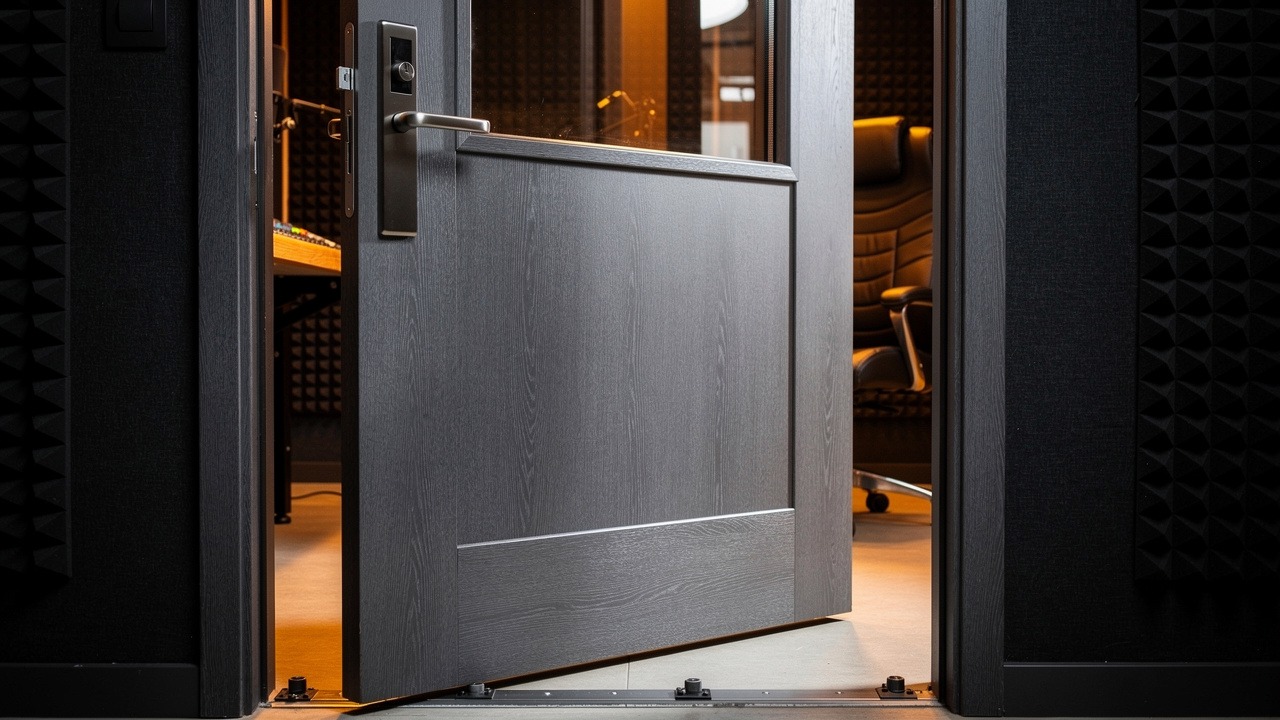
DE Sound positions itself as a wholesale acoustic materials partner for commercial, hospitality, residential, and educational projects across the Gulf region. For African project teams that source from or benchmark against Gulf suppliers, this experience brings practical benefits. The company focuses on tested products, clear pricing, and direct technical support.
DE Sound’s model centers on factory‑direct supply. That means contractors, fit‑out firms, and procurement officers can buy acoustic materials, including door systems where available, at wholesale rates suited to multi‑room or multi‑floor projects. For cost‑sensitive developments such as student housing, budget hotels, or public offices, that pricing structure can free funds for better wall or ceiling treatments.
Equally important, DE Sound emphasizes independently tested and certified acoustic products. That aligns well with commercial buildings that must document STC or Rw performance to investors, tenants, or regulators. When doors need dual fire and acoustic performance, combined certification becomes especially valuable.
The brand adds another layer through free expert consultation. Acoustic specialists at DE Sound help design teams read test reports, choose realistic STC targets, and coordinate frame, seal, and hardware details. While the company’s documented logistics focus on six GCC countries, its technical guidance still applies directly to African projects planning wooden acoustic doors. Project teams in Africa can contact DE Sound to discuss current product availability and shipping options for their specific location.
For architects and contractors working across borders, that mix of wholesale pricing, tested products, and hands‑on technical support reduces risk when specifying higher‑value items such as acoustic doors.
“Noise is an underestimated threat that can cause a number of short and long‑term health problems.”
World Health Organization, Environmental Noise Guidelines
With that warning in mind, working with suppliers who take acoustic performance as seriously as DE Sound does becomes a strategic decision, not just a purchasing choice.
Wrapping Up
Correctly specified wooden acoustic doors turn busy African commercial buildings into calmer, safer, and more private places to work, stay, learn, and heal. They combine heavy cores, smart sealing, and tested ratings into one simple component that project teams can repeat across many openings.
When designers choose suitable STC or Rw ratings, match walls and doors, and insist on complete assemblies with verified fire performance, the acoustic investment pays off. DE Sound supports that process through certified materials, wholesale pricing, and detailed guidance for teams planning projects that link Africa and the Gulf.
Conclusion
Noise control in commercial buildings is no longer a nice‑to‑have feature. Wooden acoustic doors now sit alongside lighting and HVAC as core design choices that shape comfort and performance. By reading ratings carefully, paying close attention to seals and installation, and working with partners such as DE Sound, African project teams can give occupants the privacy and calm they expect. That approach protects both building value and user wellbeing over the long term.
Frequently Asked Questions
Question: What STC rating do I need for a hotel guest room door?
An STC rating from about 38 to 45 usually suits hotel guest room entry doors. Rooms beside function halls, gyms, or rooftop venues often benefit from doors closer to STC 45 or even 50. Always match the door rating to the corridor wall, so the wall does not become the weak point in the separation.
Question: Can wooden acoustic doors also meet fire safety requirements?
Yes, many wooden acoustic doors are also tested as fire doors. Dual‑rated assemblies combine acoustic compression seals with intumescent strips that expand in heat. At specification stage, confirm whether FD30 or FD60 is needed, then request combined fire and acoustic test certificates that match the exact door, frame, glazing, and hardware package.
Question: Why is my acoustic door not performing to its rated STC?
Most performance problems come from gaps and poor sealing, not the door core. Common causes include unsealed 3‑millimeter bottom gaps, perimeter seals that do not fully compress, and hardware cutouts that are not sealed. Frame fit and careful installation are just as important as the advertised STC rating, so post‑installation acoustic checks are wise on key rooms.
Question: How long does it take to procure wooden acoustic doors for a commercial project in Africa?
Custom acoustic doors normally need several weeks from approved drawings to delivery. Timelines of around four to twelve weeks are common, depending on thickness, finish, glazing, and hardware preparation. Starting conversations with suppliers such as DE Sound during early design helps align openings, details, and lead times, so doors arrive when the project is ready for installation.