

Choosing the right acoustic panel in Dubai is not just about sound—it’s about climate, design, durability, and practicality. Two of the most popular options today are wood wool panels and PET acoustic panels. While both improve sound quality by reducing echo and reverberation, they perform differently depending on the environment and application.
Dubai’s conditions—high temperatures, humidity variations, and modern interior demands—make this comparison even more important. The right choice depends on how these materials behave in real-world use, not just lab performance.
Acoustic Performance: Which Absorbs Sound Better?
Both wood wool and PET panels are effective sound absorbers, but their performance differs slightly. PET panels typically achieve higher NRC (Noise Reduction Coefficient) values, often ranging between 0.45 to 0.95, depending on thickness and installation.
Wood wool panels also provide strong acoustic performance, usually between 0.45 to 0.90, and perform well across a broader frequency range due to their dense fiber structure.
In practical terms, PET panels are excellent for reducing echo in offices and meeting rooms, while wood wool panels handle a wider range of sound frequencies, making them suitable for larger or more complex spaces.
Durability in Dubai’s Climate
Dubai’s climate is a critical factor. Materials must withstand heat, dust, and occasional humidity without degrading.
Wood wool panels are made from natural wood fibers bonded with cement, giving them high durability and natural fire resistance. This makes them highly stable in harsh conditions and suitable for long-term installations.
PET panels, made from recycled polyester, are also durable but perform best in controlled indoor environments. They resist moisture and do not warp easily, but they rely on synthetic composition rather than structural rigidity.
For demanding environments, wood wool often has the edge in long-term durability.
Design and Aesthetic Flexibility
This is where PET panels clearly stand out. They offer a smooth, modern finish and are available in a wide range of colors, patterns, and CNC-cut designs.
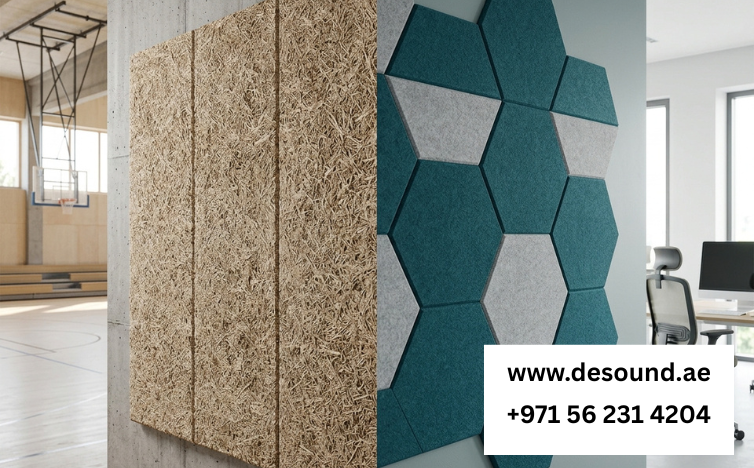
PET panels are commonly used in:
- Offices
- Commercial interiors
- Feature walls
- Modern architectural designs
Wood wool panels, on the other hand, provide a more natural, textured, and industrial look. They are ideal for spaces aiming for a raw, organic, or acoustic ceiling aesthetic.
In Dubai’s design-driven market, PET panels are often preferred for modern interiors, while wood wool is chosen for architectural or industrial-style projects.
Installation and Practical Use
PET panels are lightweight, easy to install, and can be mounted quickly on walls or ceilings. This makes them ideal for fast-track projects and retrofits.
Wood wool panels are heavier and require more structured installation, especially for ceiling applications. However, their rigidity makes them suitable for large-scale or permanent installations where strength is required.
For offices and quick upgrades, PET panels are more practical. For large commercial or industrial setups, wood wool panels provide more structural reliability.
Sustainability Considerations
Both materials are considered environmentally friendly, but in different ways.
PET panels are made from recycled plastic bottles and are fully recyclable, supporting circular economy practices.
Wood wool panels are produced from natural wood fibers, making them a renewable and low-carbon option.
The better choice depends on project priorities—recycling-based sustainability (PET) or natural material sourcing (wood wool).
Which One Works Better in Dubai?
There is no single “best” option—it depends on the application.
PET panels work better for:
- Offices and meeting rooms
- Modern interiors
- Lightweight installations
- Design-focused projects
Wood wool panels work better for:
- Large commercial spaces
- Industrial environments
- High-durability requirements
- Natural or architectural aesthetics
Call us: Contact DeSound Soundproofing Expert in Dubai For Soundproofing: +971 56 231 4204
Conclusion
Wood wool and PET panels both deliver strong acoustic performance, but they serve different purposes. PET panels are ideal for modern, flexible, and design-driven spaces, while wood wool panels offer durability, structural strength, and a natural finish suited for demanding environments.