
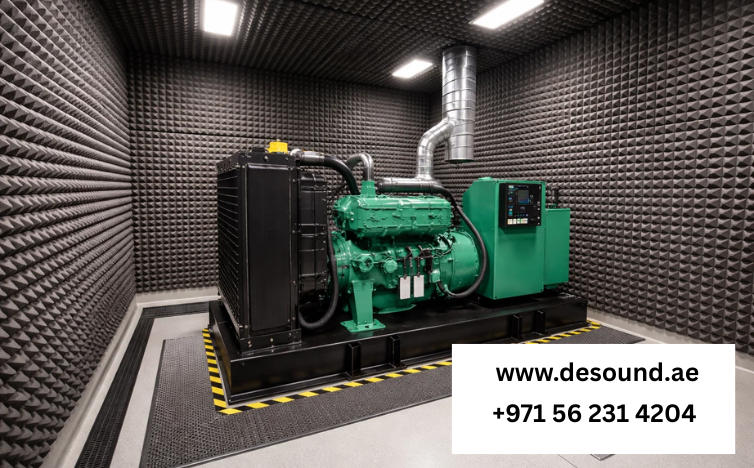
Generator rooms are one of the biggest sources of noise in industrial and commercial environments. The sound produced is not just loud—it includes low-frequency vibrations, mechanical noise, and airflow noise, making it difficult to control with basic solutions. Effective generator room soundproofing requires a combination of techniques rather than relying on a single material.
A properly treated generator room not only reduces noise pollution but also improves workplace comfort and ensures compliance with noise regulations.
Understanding Generator Noise First
Before applying any solution, it is important to understand that generator noise comes from multiple sources: the engine, exhaust system, cooling fans, and structural vibrations. Because of this, a single-layer solution will not work.
Effective soundproofing must address both airborne noise and structure-borne vibration together.
Seal All Gaps and Openings
One of the most overlooked issues in generator rooms is air gaps. Sound travels through even the smallest openings, making gaps around doors, windows, pipes, and cables a major weakness.
Sealing these gaps using acoustic sealants or foam is the first and most cost-effective step. Even minor openings can significantly reduce the effectiveness of soundproofing if left untreated.
Upgrading to solid-core doors and properly sealed windows further improves noise containment.
Control Vibration at the Source
Generators produce strong vibrations that travel through floors and walls, amplifying noise across the structure. Simply treating walls will not solve this problem.
Installing anti-vibration mounts or rubber isolation pads under the generator helps decouple it from the building structure. This prevents vibration transfer and reduces overall noise levels significantly.
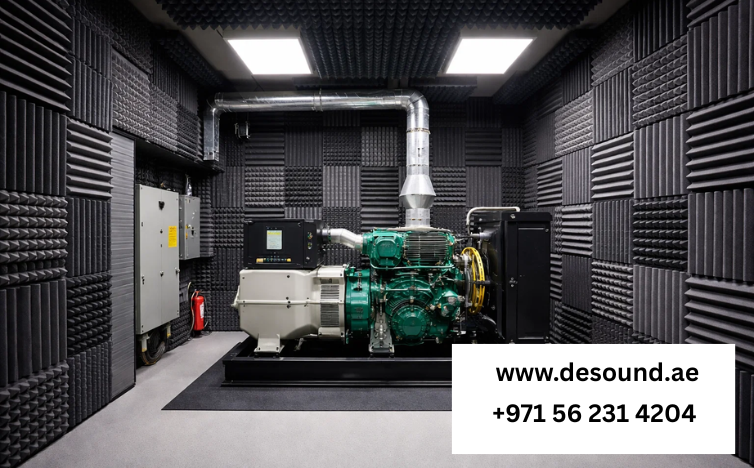
Flexible connectors for pipes and ducts also help stop vibration from spreading through connected systems.
Add Mass to Walls and Ceilings
Soundproofing depends heavily on mass. The heavier and denser the barrier, the better it blocks sound.
Walls and ceilings should be upgraded using:
- Double drywall layers
- Mass-loaded vinyl (MLV)
- Concrete or dense boards
Dense materials reduce sound transmission, especially for low-frequency generator noise, which is typically harder to control.
Install Acoustic Insulation Inside Structures
Adding insulation inside walls and ceilings improves sound absorption and reduces noise leakage.
Materials like:
- Mineral wool
- Fiberglass insulation
are highly effective because they trap sound waves and prevent them from passing through structures.
This step is essential for creating a complete soundproofing system.
Use Acoustic Panels for Internal Noise Control
While dense materials block sound, acoustic panels help control the noise inside the generator room. Without absorption, sound reflects off hard surfaces, increasing overall noise levels.
Installing acoustic wall panels and ceiling panels reduces echo and reverberation, making the space quieter and more controlled.
This is especially important for maintenance staff working near the generator.
Soundproof the Exhaust and Ventilation System
Ventilation is necessary for generator operation, but it also becomes a major pathway for noise leakage.
To solve this:
- Install high-quality exhaust silencers
- Use acoustic louvers for air intake
- Line ventilation ducts with sound-absorbing materials
- Design ducts with bends or baffles to reduce sound escape
Proper ventilation design ensures noise reduction without causing overheating issues.
Consider a Generator Enclosure or Room-in-Room System
For maximum noise reduction, a full enclosure or “room within a room” approach is highly effective.
This involves:
- Building a secondary isolated structure
- Using decoupled walls and ceilings
- Combining mass, insulation, and air gaps
Such systems significantly reduce noise transmission and are commonly used in industrial soundproofing projects.
Combine Multiple Solutions for Best Results
Generator soundproofing is not achieved with one product. It requires a layered approach that includes:
- Sealing gaps (airtightness)
- Adding mass (blocking sound)
- Absorption (reducing reflections)
- Decoupling (stopping vibrations)
Combining these methods creates a complete system that effectively reduces noise across all frequencies.
Call us: Contact DeSound Soundproofing Expert in Dubai For Soundproofing: +971 56 231 4204
Final Thoughts
Making a generator room soundproof requires a strategic and multi-layered approach. From sealing gaps and controlling vibration to upgrading walls and optimizing ventilation, each step plays a critical role in reducing noise.
A properly designed system doesn’t just make the generator quieter—it improves safety, enhances working conditions, and ensures long-term operational efficiency.