
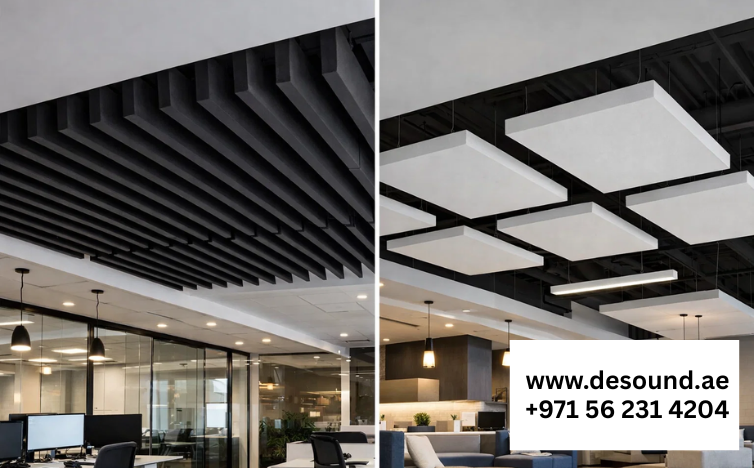
Ceiling acoustics play a major role in how a space sounds and feels, especially in modern interiors where hard surfaces like glass, concrete, and metal dominate. When sound reflects off these surfaces, it creates echo and noise buildup that affects communication, comfort, and overall functionality. This is where solutions like ceiling baffles and ceiling rafts are used—but they are often confused as the same product.
While both improve acoustics, ceiling baffles and ceiling rafts are designed differently and serve distinct purposes. Understanding this difference is essential before choosing the right solution for your space.
Understanding the Structural Difference
The most fundamental difference between ceiling baffles and ceiling rafts lies in how they are installed. Ceiling baffles are suspended vertically from the ceiling, usually in parallel rows, creating a series of hanging panels that interact with sound traveling across the space. Ceiling rafts, in contrast, are installed horizontally, appearing like floating panels positioned slightly below the ceiling surface.
This structural variation significantly impacts how each solution controls sound. Baffles work by intercepting sound waves moving laterally through the room, while rafts absorb sound from above and below, reducing overall reverberation within the space.
How Ceiling Baffles Control Sound
Ceiling baffles are particularly effective in large, open environments where sound travels freely across long distances. Because they are installed vertically, they expose more surface area to sound waves, allowing them to absorb noise from multiple angles. This makes them highly efficient at breaking up echo paths and controlling sound movement in expansive areas.
They are commonly used in spaces such as open-plan offices, industrial facilities, gyms, and public buildings where ceiling heights are higher and sound needs to be controlled over a wider area. Their ability to disrupt sound waves mid-air makes them a strong choice for environments with significant noise buildup.
How Ceiling Rafts Improve Acoustic Balance
Ceiling rafts function differently by focusing on creating a balanced acoustic environment rather than targeting specific sound paths. Installed horizontally, they act as suspended absorptive surfaces that reduce sound reflections from the ceiling and distribute acoustic control evenly across the room.
This makes them suitable for spaces where speech clarity and comfort are priorities, such as meeting rooms, classrooms, restaurants, and offices. By reducing reverberation uniformly, rafts help create a more controlled and pleasant acoustic atmosphere without overwhelming the visual design of the space.
The Importance of Ceiling Height
Ceiling height is a critical factor when choosing between baffles and rafts. In spaces with high ceilings, baffles are generally more effective because they can hang freely and interact with sound over a larger vertical volume. Their design allows them to manage sound in environments where traditional ceiling treatments may not be sufficient.
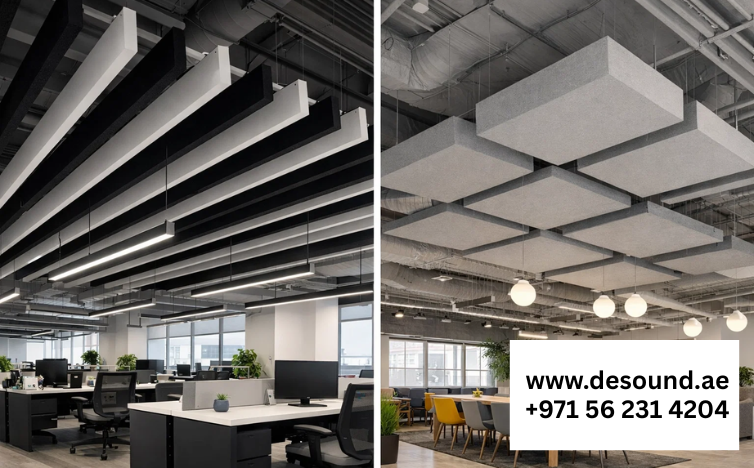
In contrast, rafts are better suited for spaces with lower ceilings, where vertical installations might reduce headroom or create a crowded appearance. Their flat, suspended design allows them to provide effective sound absorption without affecting the openness of the space.
Performance Differences in Real Environments
In practical terms, ceiling baffles provide more targeted acoustic control, especially in large or noisy environments where sound travels across open areas. They are designed to interrupt and absorb sound waves as they move through the space, making them effective in controlling noise spread.
Ceiling rafts, on the other hand, offer more uniform sound absorption, reducing overall echo and improving clarity throughout the room. Instead of focusing on specific sound paths, they enhance the general acoustic quality of the environment.
Both solutions are effective, but their performance depends entirely on how they are matched to the space.
Aesthetic Considerations
Beyond performance, design also plays an important role in selecting the right acoustic solution. Ceiling baffles create a more dynamic and architectural appearance, often used to add visual depth and structure to large spaces. They can be arranged in patterns and configurations that enhance the overall design.
Ceiling rafts provide a cleaner and more minimal look, blending seamlessly into modern interiors. Their subtle appearance makes them ideal for environments where aesthetics need to remain simple and unobtrusive.
The choice often depends on whether the goal is to make a visual statement or maintain a minimal ceiling design.
Choosing the Right Solution for Your Space
Selecting between ceiling baffles and ceiling rafts should be based on the specific requirements of the space rather than preference alone. Large, open areas with high ceilings and significant noise levels benefit more from baffles due to their ability to control sound movement across wide spaces. Smaller or more enclosed environments that require balanced sound absorption and improved clarity are better suited for rafts.
In some cases, a combination of both solutions can be used to achieve optimal results. Baffles can handle large-scale sound movement, while rafts manage overall reverberation, creating a well-balanced acoustic environment.
Call us: Contact DeSound Soundproofing Expert in Dubai For Soundproofing: +971 56 231 4204
Final Thought
Ceiling baffles and ceiling rafts may appear similar, but they are designed for different acoustic challenges. Choosing the right one depends on understanding how sound behaves in your space and selecting a solution that addresses that behavior effectively.