
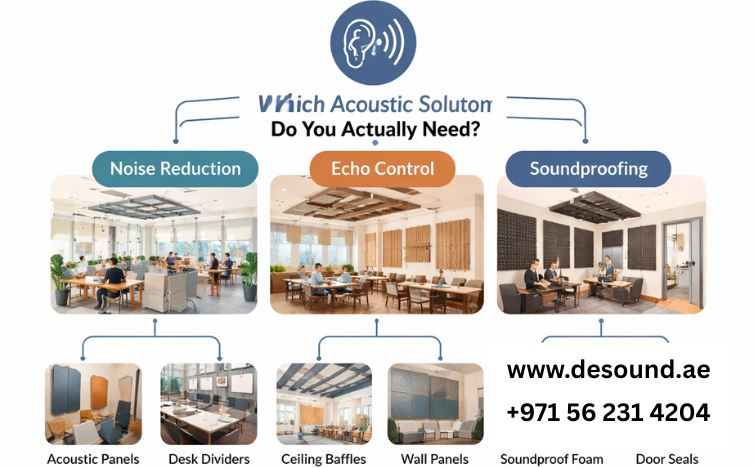
Most people think they have a noise problem, but in reality, they have a misunderstanding problem. Sound issues in any space are rarely simple, yet they are often treated with one-size-fits-all solutions. This is why many offices, studios, restaurants, and industrial facilities invest in acoustic products but still struggle with echo, noise leakage, or poor sound clarity. The real challenge is not finding a solution—it is identifying the exact type of acoustic problem before choosing one.
Start Here: Identify the Type of Noise Problem
Every acoustic issue falls into one of two primary categories: sound reflection or sound transmission. Sound reflection occurs when noise bounces within a space, creating echo and reducing clarity. Sound transmission, on the other hand, happens when noise travels from one area to another, either entering or leaving a room. Understanding this distinction is critical because each problem requires a completely different approach.
Research in architectural acoustics shows that most ineffective installations happen when reflective noise issues are treated with soundproofing materials, or when transmission problems are addressed using basic acoustic panels. This mismatch leads to poor results and unnecessary expenses.
Acoustic Panels: The Right Choice for Echo and Clarity
Acoustic panels are designed to manage sound inside a room rather than block it. They are made from sound-absorbing materials such as foam, mineral wool, or fiberglass, which reduce reflections and improve clarity. When sound waves hit these surfaces, they are absorbed instead of bouncing back into the room.
This makes acoustic panels ideal for environments where speech clarity and comfort are important. Offices, meeting rooms, restaurants, and studios benefit significantly from these solutions because they reduce background noise buildup and eliminate echo. As a result, conversations become clearer and less effort is required to communicate.
However, it is important to understand their limitation. Acoustic panels do not stop sound from entering or leaving a space. If external noise is the issue, panels alone will not solve the problem.
Soundproofing Solutions: Blocking Noise at the Source
When the issue involves noise traveling between spaces, soundproofing becomes necessary. Unlike acoustic panels, soundproofing solutions focus on preventing sound transmission by using dense and layered materials that block sound waves.
Common soundproofing methods include insulated walls, double-layer drywall systems, acoustic barriers, and specialized glazing. These solutions increase the mass and density of structures, which reduces the ability of sound to pass through them.
According to industry standards, materials with higher Sound Transmission Class (STC) ratings provide better noise isolation. This is particularly important in residential buildings, offices, and commercial spaces where privacy and noise control are essential. Soundproofing is also widely used in urban environments to reduce traffic noise and external disturbances.
Acoustic Barriers and Enclosures: Controlling Industrial Noise
In industrial environments, noise often originates from specific machines rather than the entire space. In such cases, treating the whole room is inefficient. Instead, the focus should be on controlling noise at its source.
Acoustic barriers and enclosures are designed for this purpose. Barriers block sound from spreading across areas, while enclosures contain noise within a defined space around machinery. These solutions are commonly used in factories, workshops, and mechanical rooms where equipment generates continuous high-level noise.
Studies in industrial noise control show that source-based solutions, such as enclosures, can significantly reduce overall noise levels when properly installed. This approach not only improves the working environment but also helps meet safety and compliance requirements.
When Vibration Becomes the Hidden Problem
Not all noise travels through air. In many cases, sound is transmitted through vibration. Machinery and heavy equipment can transfer vibrations into floors, walls, and structural elements, which then convert into audible noise in other areas.
This type of problem cannot be solved with panels or barriers alone. It requires vibration isolation techniques such as anti-vibration mounts, isolation pads, and structural decoupling. These methods prevent mechanical energy from spreading through the building, effectively reducing secondary noise.
Ignoring vibration often leads to incomplete results, even when other acoustic treatments are applied. For this reason, it is an essential factor in comprehensive acoustic planning.
Why One Solution Is Rarely Enough
Real-world acoustic problems are usually a combination of multiple factors. A space may have echo issues, external noise intrusion, and vibration-related disturbances at the same time. Addressing only one aspect will not fully resolve the problem.
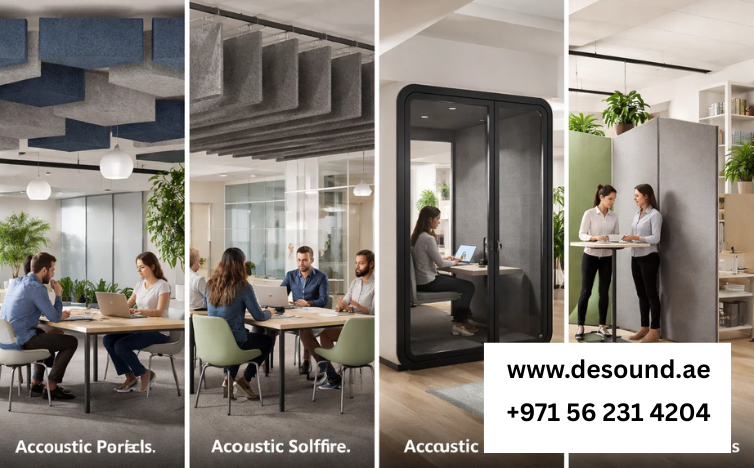
Industry experts emphasize that effective acoustic treatment often combines absorption, sound blocking, and vibration control. For example, adding acoustic panels without addressing sound leakage may improve clarity but will not reduce external noise. Similarly, installing barriers without absorption can lead to increased echo within the space.
A balanced approach ensures that all aspects of sound behavior are managed effectively.
Matching the Solution to the Space
Different environments require different acoustic strategies. Offices and meeting rooms typically need sound absorption to improve communication and reduce echo. Restaurants and hospitality spaces benefit from a combination of wall panels and ceiling treatments to control noise buildup and enhance customer comfort.
Industrial facilities require more advanced solutions, including machine enclosures, barriers, and vibration isolation systems, to manage high noise levels and ensure worker safety. Residential spaces often focus on soundproofing to block external noise and maintain privacy. Studios and recording environments require precise acoustic control, combining absorption and isolation to achieve optimal sound quality.
Choosing the right solution depends entirely on the specific challenges of the space rather than general assumptions.
The Cost of Choosing the Wrong Acoustic Solution
Selecting the wrong acoustic treatment can lead to wasted investment and ongoing frustration. Installing products that do not address the actual problem often results in minimal improvement, forcing additional spending on corrections later.
Industry estimates suggest that improper acoustic planning can increase overall project costs significantly due to rework and ineffective installations. This highlights the importance of proper assessment before implementation.
Call us: Contact DeSound Soundproofing Expert in Dubai For Soundproofing: +971 56 231 4204
Final Thought: Solve the Right Problem First
Acoustic solutions are highly effective when applied correctly, but they are not interchangeable. Each product is designed for a specific purpose, and using it outside that context reduces its effectiveness.
Before selecting any solution, the focus should be on identifying whether the issue is related to echo, noise transmission, or vibration. Once the root cause is clear, the appropriate treatment becomes obvious.