
Fujairah is different from the rest of the UAE in ways that matter to anyone thinking about acoustics. The mountain backdrop. The relative quiet of a smaller emirate. The absence of the relentless urban density that defines Dubai or Sharjah. People choose Fujairah for its pace, its landscape, and the particular quality of life that comes from not being surrounded by eight million other people.
Which makes it notably ironic that inside many Fujairah homes, the noise situation is worse than residents expected when they moved in. Not the dramatic, relentless noise of a major city — but the specific, persistent, and strangely inescapable noise that comes from coastal winds hammering poorly sealed window frames, from the trucks and container traffic that defines the emirate’s port economy, from the hard-surface construction common in newer residential developments that turns every footstep and television into a room-filling event.
Fujairah deserves better homes acoustically. The solutions are straightforward.
The Port Economy Nobody Mentions in Property Listings
Fujairah is one of the world’s most significant bunkering ports. That’s an economic asset that drives significant employment and commercial activity — and a noise reality that property listings reliably omit.
Heavy vehicle traffic servicing the port, the industrial areas along the coastal road, and the commercial logistics operations running around the clock creates a sustained low-frequency noise environment along Fujairah’s main arterials and in residential areas that developed adjacent to commercial corridors. This is not peak-hour traffic noise. It’s a continuous background presence that is particularly intrusive at night when other ambient sounds drop and the rumble of port traffic becomes the dominant acoustic feature of a bedroom facing the wrong direction.
Acoustic laminated glass windows are the primary fix for this. The multi-layer construction with PVB interlayer targets the mid-frequency range where truck and road traffic concentrates most of its energy. Properly installed with sealed frames — which matters as much as the glass specification itself — they reduce traffic noise intrusion by 35 to 45 decibels in real-world conditions. That converts a bedroom where traffic is an active presence into one where it has effectively disappeared.
Wind Noise — Fujairah’s Underappreciated Acoustic Problem
Coastal and mountain-adjacent locations experience wind in ways that urban environments don’t. Fujairah’s position between the Hajar Mountains and the Gulf of Oman creates wind channelling effects that drive sustained and sometimes intense wind noise into buildings — particularly through window frames and door perimeters that weren’t sealed with this in mind.
Wind noise through gaps is a different acoustic problem from traffic noise through glass. The glass is not the culprit — the gaps around it are. Window frame seals that have aged and compressed, door perimeter seals that never provided adequate contact, the small gaps around fixed glazing where the frame meets the wall — these are the transmission paths. Acoustic sealant applied to frame perimeters and proper compression seals on opening windows close these paths at minimal cost and produce immediate, perceptible results that often surprise homeowners with how much of what they thought was unavoidable was actually just unaddressed.
Hard Surfaces Everywhere — The Internal Echo Nobody Designed For
Fujairah’s residential construction follows the same hard-surface aesthetic that dominates across the UAE — marble and large-format tile floors, plastered walls, high ceilings in newer villas and apartments. The result is beautiful to look at and acoustically punishing to live in.
A typical Fujairah villa living room with tiled floors, bare walls, and a 3-metre ceiling can produce reverberation times above 1.5 seconds. Every conversation, every television at normal volume, every kitchen noise from an open-plan layout echoes and layers until the cumulative noise floor of the house itself is fatiguing. Residents often describe these homes as “loud” without being able to identify why — because there’s no single noise source. The room itself is the problem, amplifying everything equally.
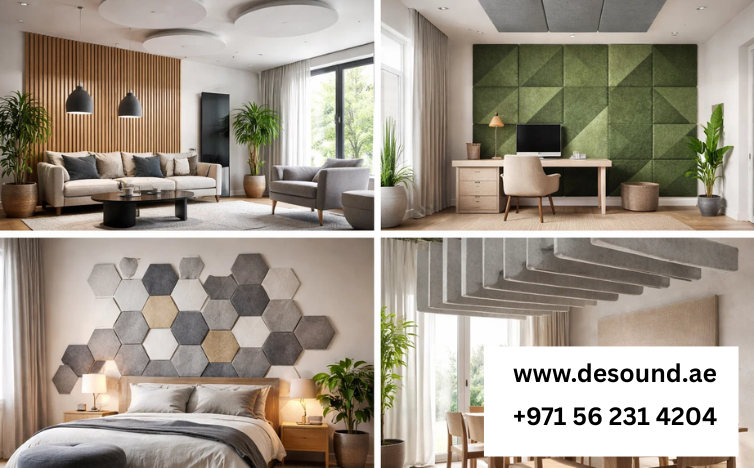
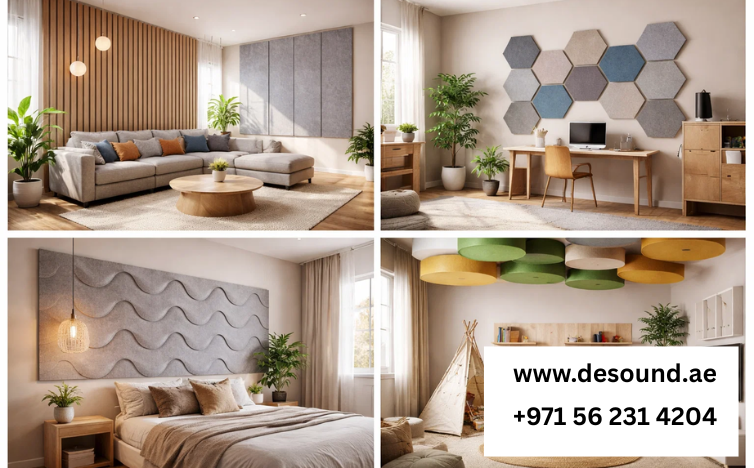
Acoustic wall panels — PET or acoustic wood wool — on key reflective surfaces reduce this reverberation to a comfortable range without deadening the space entirely. The target is 0.5 to 0.8 seconds for living areas — lively enough to feel natural, controlled enough that conversation and audio content are clear rather than smeared. A relatively small coverage area on the right wall surfaces achieves this, making the treatment both cost-effective and visually unobtrusive when integrated into the interior design from the outset.
The Apartment Buildings Fujairah Is Building More Of
Fujairah’s residential development trajectory has shifted toward mid-rise apartment buildings over the last several years — a response to population growth and the preferences of the emirate’s growing expat workforce. This brings a specific set of acoustic challenges that villa-focused residents haven’t historically dealt with in Fujairah.
Shared floor-ceiling assemblies between apartments transmit both airborne sound and impact noise between units. The tenant above walking on a hard floor at midnight. The neighbour’s television through a partition wall that was built to the minimum specification the budget allowed. These are the noise complaints that fill property management inboxes in every apartment building that didn’t address acoustics at the design stage — and in Fujairah’s newer stock, the design stage rarely included acoustic consideration.
For residents in these buildings, the practical options are Mass Loaded Vinyl on shared walls for airborne transmission, acoustic floor underlay on upper-level floors for impact transmission control, and acoustic door seals to close the gap-transmission paths that standard apartment doors leave open. None of these require structural modification. All of them are landlord-permission-friendly in most cases. Together they meaningfully change the acoustic relationship between neighbouring units without anyone having to move or renovate.
Children and Sleep — The Residential Acoustic Priority That Overrides All Others
Across every type of residential space in Fujairah — villas, apartments, compounds — the acoustic treatment conversation that matters most to families is the simplest one. Children need sleep. Good sleep. Uninterrupted sleep. And Dubai and UAE research consistently shows that standard residential construction does not provide the acoustic environment that genuinely supports it.
The primary interventions for children’s bedrooms are acoustic window treatment — particularly in rooms facing roads or commercial areas — and door sealing to prevent noise from active household areas reaching sleeping children. These two measures address the two most common sleep disruption paths: external noise infiltration and internal household noise transmission. Combined, they change the bedroom from a space where sleep happens despite the acoustic environment into one where the acoustic environment actively supports it.
For Fujairah families who’ve accepted early morning wake-ups from port traffic, light sleepers in the household, or nap routines that collapse whenever someone moves in the next room — the physical cause of these disruptions is identifiable and fixable. It’s not the child, and it’s not bad luck. It’s unsealed windows and gaps that acoustic treatment closes permanently.
The Renovation Timing That Saves the Most Money
A recurring pattern in residential acoustic treatment across the UAE — and Fujairah is no exception — is homeowners treating acoustic solutions as a problem to solve after a renovation rather than a consideration to build into it.
Installing acoustic floor underlay before the tile or timber floor goes down costs a fraction of what it costs to lift a finished floor to install it afterward. Acoustic window frames and glass are most cost-effectively specified and installed when windows are being replaced as part of a broader renovation. Acoustic panel installation is cleaner, faster, and less disruptive during a fit-out than after furniture and finishes are in place.
The residents who get the best acoustic outcomes in Fujairah are the ones who include it in the renovation brief from day one — not as an afterthought when the work is done and the noise problem persists despite everything else being improved. If a renovation or new build is being planned, the acoustic conversation belongs in the first meeting, not the last.
Call us: Contact DeSound Soundproofing Expert in Oman For Soundproofing: +971 56 231 4204
What a Proper Assessment Actually Involves
Committing to acoustic treatment without an assessment is the equivalent of buying medication without a diagnosis. The products that solve a wind noise infiltration problem are different from the products that solve an internal reverberation problem, which are different again from the products that solve an impact transmission problem from the floor above. Applying the wrong solution to the wrong problem produces disappointed homeowners and wasted budgets.
A proper residential acoustic assessment for a Fujairah home involves identifying the primary noise complaint, measuring or estimating the existing acoustic conditions, identifying the transmission paths, and specifying a product combination that addresses those paths directly.