
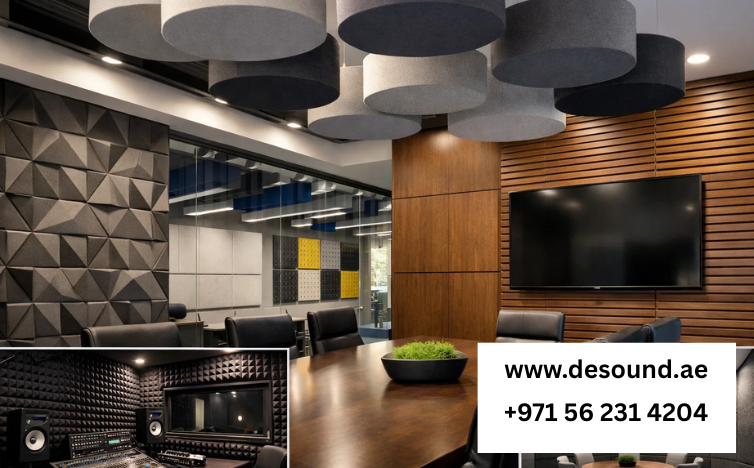
There’s a particular kind of noise problem that businesses normalise so completely they stop experiencing it as a problem at all. It becomes the background condition of work — the open-plan office where everyone wears headphones, the conference room where people lean forward to hear each other, the client meeting area where conversations drift into adjacent spaces. Nobody files a complaint. The noise just becomes part of how things are.
Kuwait’s commercial sector has been doing this for years. The acoustic quality of Kuwait’s business environments — across Kuwait City’s commercial districts, the Shuwaikh industrial and business areas, the Hawalli and Rumaithiya office stock — is significantly below what professional work actually requires. Not because Kuwaiti businesses don’t care about quality. Because acoustic treatment was never positioned as the productivity and professional infrastructure investment it actually is.
That positioning is overdue for a change.
What Kuwait’s Commercial Environment Actually Sounds Like
Kuwait City’s commercial architecture has followed the same trajectory as the broader Gulf market — glass curtain wall facades, open-plan floor plates, hard surface finishes throughout, minimal acoustic consideration at the design stage. The specific combination of Kuwait’s urban density and its particular building stock creates a noise profile that has a character worth understanding before specifying any treatment.
The Gulf Road corridor, the commercial towers along Abdullah Al Mubarak Street, the business complexes in Sharq and Qibla — all of these sit in urban environments where traffic noise, construction activity, and the general acoustic energy of a dense commercial city penetrate building facades that were not designed to resist them. Kuwait’s coastal wind patterns add another dimension — wind-driven noise through imperfect window and door seals is a complaint that comes up consistently in Kuwait City offices that don’t have a traffic noise problem but still have a noise problem they can’t identify the source of.
Internally, Kuwait’s commercial buildings exhibit the same acoustic failures that affect similar buildings throughout the region. Open-plan offices where ambient noise builds throughout the day as more people work simultaneously. Conference rooms where conversations broadcast to adjacent spaces through lightweight partitions and under-door gaps. Reception areas and client-facing spaces where the acoustic character of the room undermines the professional impression the business is trying to make.
The Productivity Cost Kuwait Businesses Are Absorbing Without Knowing It
The research on noise and knowledge work productivity is extensive enough that it has moved beyond academic literature into mainstream management awareness. What’s less well-understood is the specific financial scale of what uncontrolled office noise costs.
A 2019 Oxford Economics study found that employees in acoustically uncontrolled open-plan environments lose an average of 86 minutes of productive work time daily to noise-related distraction. In a Kuwait business with 30 knowledge workers — a medium-sized professional services firm, a bank branch, a technology company’s regional office — that’s 43 hours of productive capacity lost every single working day. At any realistic salary cost for professional-grade employees in Kuwait’s labour market, the monthly value of that lost productivity significantly exceeds the cost of comprehensive acoustic treatment for the entire office.
This calculation rarely gets made because the cost is invisible — distributed across everyone’s daily experience rather than appearing as a line item on any budget. But it is real, it is consistent, and it is entirely preventable. Professional acoustic services address it directly and permanently. The treatment is a one-time capital investment. The productivity return compounds every working day from installation forward.
Kuwait’s Banking and Financial Services Sector — A Specific Case
Kuwait’s banking sector is one of the most significant in the Gulf relative to the country’s size. The concentration of financial institutions along the commercial districts of Kuwait City — conventional banks, Islamic banking operations, investment companies, insurance firms — creates a category of commercial environment where acoustic quality intersects directly with regulatory and professional obligation.
Client confidentiality in financial services is not a preference. It’s a professional requirement. A wealth management meeting in a glass-fronted office where the conversation is audible to people waiting in the adjacent reception area is not just uncomfortable — it’s a compliance problem. A credit assessment discussion in a conference room with a 5mm door gap and no wall treatment is broadcasting information that should be contained. These aren’t hypothetical scenarios. They’re the daily operational reality of financial offices in Kuwait City that haven’t addressed their acoustic infrastructure.
Acoustic glass partitions, acoustic doors with proper perimeter sealing, and wall treatment in client meeting areas represent the minimum acoustic specification for any Kuwait financial services environment that takes client confidentiality seriously. The cost is modest relative to the fit-out budget of any serious commercial office. The alternative — operating in spaces that structurally cannot contain sensitive conversations — is a professional liability that no compliance policy can fully offset.
Food and Beverage — Kuwait’s Most Acoustically Neglected Commercial Sector
Kuwait’s restaurant and café market has grown significantly over the last decade. The dining culture — strong, social, and anchored in extended meal experiences — makes acoustic quality particularly important compared to markets where dining is faster and more transactional. And yet the acoustic treatment of Kuwait’s restaurant interiors consistently lags behind the investment made in every other aspect of the design.
The pattern is predictable. A restaurant in Salmiya or Mahboula opens with beautiful interiors — careful attention to lighting, furniture, branding, menu design. The floors are stone or polished concrete. The ceiling is exposed or features decorative hard elements. The walls are bare plaster or tile. Within weeks of opening at capacity, the noise level during busy periods makes conversation across a table difficult, and the reviews start mentioning “too loud” or “couldn’t hear each other” alongside otherwise positive assessments. The owners invest in better marketing. The acoustic problem remains.
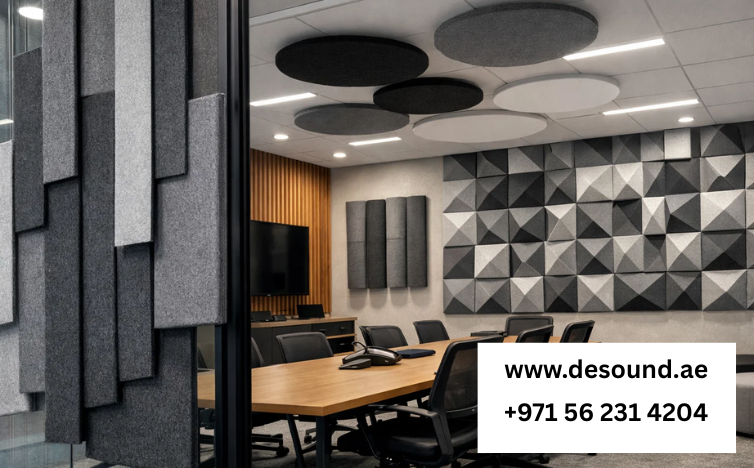
Acoustic ceiling baffles and wall panels — specified for the aesthetic register of the space, not bolted on as an afterthought — address this directly. The reverberation time of a well-treated Kuwait restaurant sits between 0.8 and 1.2 seconds: lively enough to feel vibrant and social, controlled enough that table conversations are intimate and clear. PET panels in custom colours or acoustic wood panels that fit the material language of the interior can achieve this invisibly — the client experiences a space that simply feels right without being able to identify the acoustic treatment as the reason.
Government and Semi-Government Buildings in Kuwait
Kuwait’s public sector is a significant employer and a major driver of commercial space demand. Government ministries, semi-government entities, and public service buildings across Kuwait City house thousands of workers and serve hundreds of thousands of citizens annually. The acoustic quality of these spaces matters for both operational efficiency and public service delivery — and it’s an area where Kuwait has significant room for improvement.
Public service environments where citizens interact with government staff face a specific acoustic challenge: speech intelligibility across a counter or desk in a noisy open environment. When background noise in a government service hall exceeds 65 decibels — common in untreated high-volume public spaces — the signal-to-noise ratio for face-to-face communication falls to a level that increases errors, requires repetition, and creates frustration for both the citizen and the government employee. Acoustic ceiling treatment and strategically placed wall panels in public service areas improve speech intelligibility measurably and reduce the cognitive load of every transaction that takes place in the space.
Government meeting rooms and decision-making spaces carry their own acoustic requirements. Discussions at the policy and operational level require containment — not just for confidentiality but for the quality of the deliberation itself. Research published in the Journal of Environmental Psychology consistently shows that decision quality degrades in acoustically stressful environments. Kuwait’s public sector buildings deserve acoustic infrastructure that supports the quality of work happening inside them.
The Kuwait Climate Factor in Material Specification
Kuwait’s climate is among the most extreme in the world — summer temperatures regularly exceeding 50°C, humidity that swings between the dry interior desert conditions and the more humid coastal and summer conditions. Any acoustic treatment specification for Kuwait that doesn’t account for this thermal and humidity profile is importing a performance assumption from a temperate climate that will not hold in practice.
Materials with organic or natural fibre cores can absorb moisture during Kuwait’s more humid periods and release it during dry conditions, cycling in ways that progressively affect both acoustic performance and material integrity. PET panels — fully synthetic, non-hygroscopic, and temperature-stable across the range Kuwait experiences — are the appropriate default wall panel specification for Kuwait commercial buildings. Acoustic wood wool panels, properly sealed with appropriate facing, also perform well in the Gulf climate when specified correctly.
The fire rating requirement is equally non-negotiable. Kuwait’s civil defence regulations for public commercial occupancy spaces require Class A fire resistance from all surface-mounted materials. Every acoustic product specified for a Kuwait commercial project should carry documentation confirming compliance with this requirement — and any supplier that cannot provide this documentation should not be on the specification list regardless of price point.
Call us: Contact DeSound Soundproofing Expert in Kuwait For Soundproofing: +971 56 231 4204
The Business Case That Makes the Decision Simple
Strip away every technical consideration and the business case for professional acoustic services in Kuwait reduces to three questions. Is noise affecting the quality of work happening in your space? Is it affecting the experience of clients who visit? Is it creating any professional or compliance risk for the business?
For the majority of Kuwait’s commercial businesses — in financial services, hospitality, retail, professional services, and government operations — the honest answer to at least one of these questions is yes. The treatment exists, it’s available, it’s specified for Kuwait’s climate, and the investment is modest relative to the operational value it restores.