
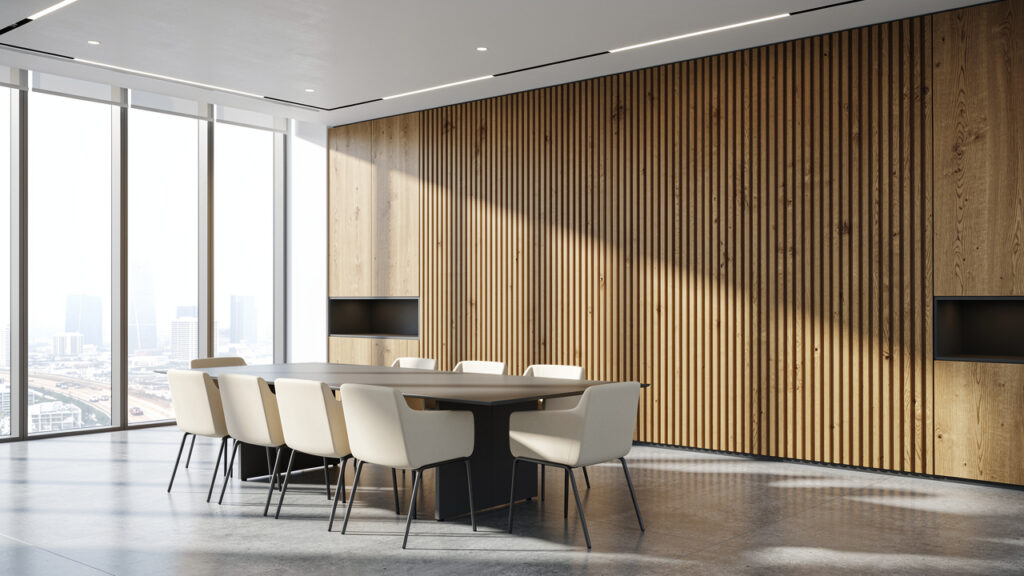
Noise that bounces around a room ruins meetings, recordings, and guest experiences because hard floors and glass walls keep reflecting sound. Room Acoustics with Decorative Wooden Acoustic Panels controls echo while keeping interiors aligned with high design standards in the UAE and GCC.
These panels combine a visible wooden face with an acoustic core that absorbs reflected sound. They shorten reverberation time, make speech clearer, and reduce listener fatigue in offices, hotels, schools, studios, and homes. This guide explains what they are, the main types, where they have the most impact, how to install them, and how DE Sound supports Gulf projects with certified products and technical help.
Keep those spaces in mind as you read; the next section explains how the panels work inside a room.
What Are Decorative Wooden Acoustic Panels and How Do They Work?

Decorative wooden acoustic panels are finished wall or ceiling elements that control sound while blending into the interior design. They sit on top of an acoustic backing, so they look like joinery yet work like technical treatment. For anyone planning Room Acoustics with Decorative Wooden Acoustic Panels, this dual role keeps spaces quiet and visually polished.
Whenever sound from a voice or speaker hits a surface, three things happen, and a short review of the impact of wooden panels on room acoustics confirms that the balance between reflection, absorption, and diffusion is directly influenced by the species, profile, and installation method of the timber face. Some energy bounces straight back as reflection, some becomes heat inside soft materials as absorption, and some scatters in different directions as diffusion. A good room balances these behaviors instead of letting hard concrete, glass, and gypsum dominate every surface.
Most panels from DE Sound use a slatted, grooved, or perforated face in MDF or plywood bonded to polyester fiber or mineral wool, and recent research on Application of Hybrid Absorptive–Diffusive panel configurations confirms that combining wooden overlays with acoustic backings meaningfully improves room absorption across mid and high frequencies. Gaps between the slats or perforations let sound enter the acoustic core, where friction inside the fibers reduces energy. The timber face still reflects part of the sound, preserving a natural sense of life in the room.
According to ASTM International, the Noise Reduction Coefficient (NRC) uses a scale from 0.00 to 1.00 based on standardized absorption tests. High performance decorative panels commonly reach NRC values between about 0.55 and 0.90 when tested to ISO 354 or ASTM C423. Classroom guidance from the Acoustical Society of America links RT60 around 0.4 to 0.6 seconds with clear speech. By matching NRC and RT60 targets to each room type, designers gain predictable, repeatable results.
Types of Decorative Wooden Acoustic Panels for Every Space
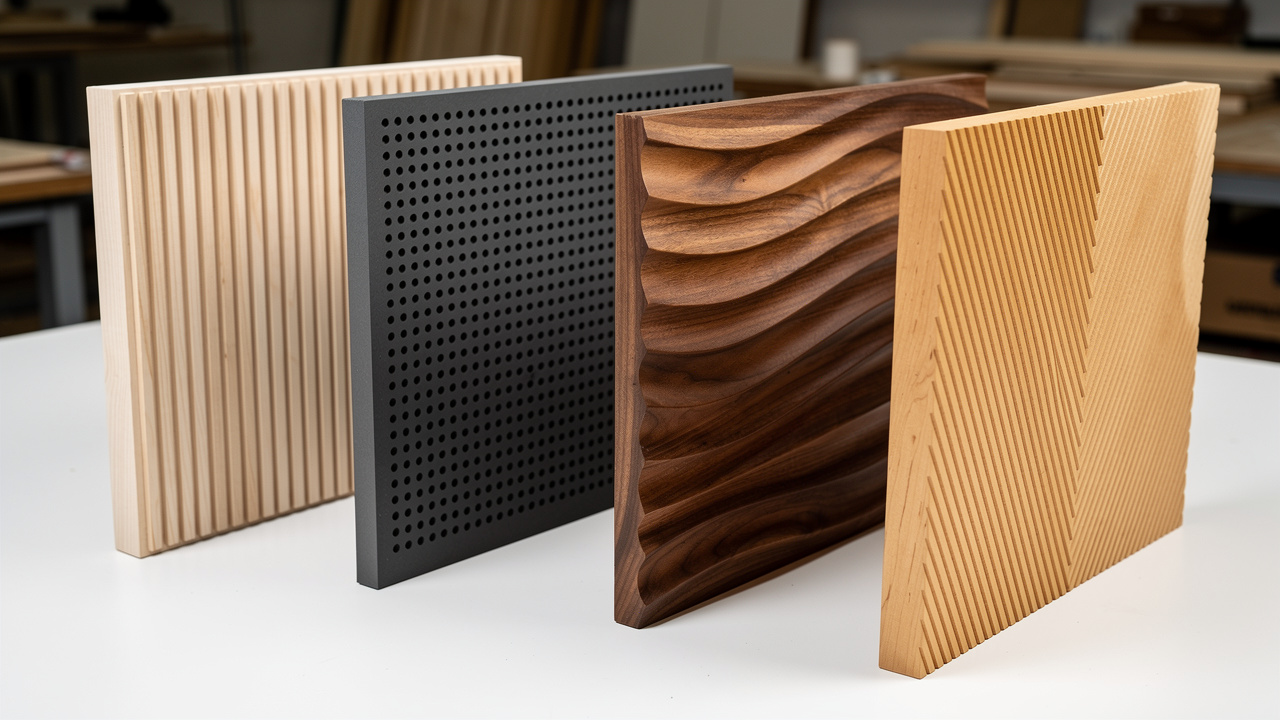
Types of decorative wooden acoustic panels differ in face pattern, thickness, and core material, which changes how they interact with sound. Choosing between slatted, perforated, sculpted, and grooved faces lets designers fine tune absorption and diffusion for each project. For Gulf projects in Dubai, Abu Dhabi, and Riyadh, that choice also affects durability under air conditioning and humidity, especially when planning Room Acoustics with Decorative Wooden Acoustic Panels across many rooms.
A few of the most widely used options are summarized below.
| Panel Type | How It Works | Typical Applications |
|---|---|---|
| Slatted / Slotted | Narrow timber strips fixed over an acoustic backing; gaps let mid and high frequencies reach the core while the visible wood reflects some sound. | Executive offices, lobbies, coworking areas, production and content studios. |
| Perforated MDF or Plywood | Evenly spaced holes across the face allow sound to pass through; hole size and spacing tune which frequencies are absorbed, and surfaces can be painted or veneered to match the palette. | Universities, auditoriums, meeting rooms, large open plan offices. |
| Three Dimensional Sculpted | Wave, pyramid, or hexagon profiles scatter sound to break up flutter echo instead of absorbing everything. | Music rooms, hotel feature walls, residential media rooms. |
| Grooved / V Groove | Shallow channels guide energy into the backing material in a subtle way, giving moderate absorption with a calm visual pattern. | Corridors, boardrooms, prayer halls, spaces that need better control without a busy texture. |
Linear slat patterns read as modern joinery rather than exposed treatment, which is why they are widely used in UAE coworking spaces and content studios.
Research from the Forest Products Laboratory shows that solid timber moves more with humidity swings than engineered boards. This is why DE Sound usually recommends MDF core panels with stable veneer faces for UAE projects that run air conditioning around the clock.
Where Decorative Wooden Acoustic Panels Make the Biggest Impact
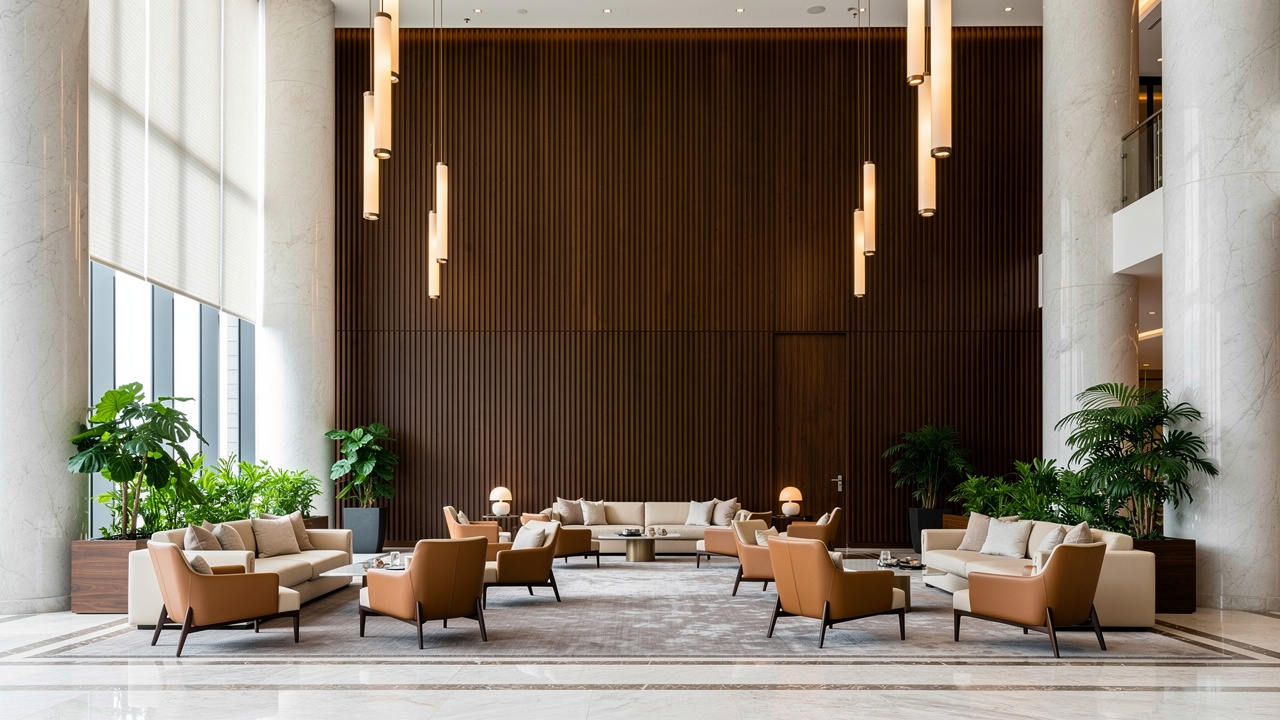
Decorative wooden panels make the biggest difference in spaces where noise control and visual quality matter at the same time. Recording facilities, workplaces, hospitality venues, schools, and home theaters all benefit when reverberation sits inside the right range. In each of these settings, Room Acoustics with Decorative Wooden Acoustic Panels gives a more refined look than exposed foam or plain fabric tiles.
In recording studios and podcast booths, the goal is a tight response with very low RT60, typically around 0.2 to 0.4 seconds according to the Audio Engineering Society. Slatted or perforated wood panels on side walls, rear walls, and ceilings manage early reflections while still looking professional on camera for content creators.
Corporate offices and meeting rooms in business districts such as Dubai International Financial Centre often suffer from open ceilings, glass partitions, and high background noise. The World Health Organization links steady background levels above roughly 55 decibels in workplaces with reduced comfort and performance. Installing wood faced acoustic panels on meeting room walls, focus areas, and breakout zones can bring RT60 closer to about 0.4 to 0.6 seconds so speech stays clear on site and on video calls.
Hotel lobbies, all day dining spaces, and rooftop venues across brands such as Marriott and Hilton rely on a certain energy without turning into a shout, and a Multifunctional performance assessment of wall panel systems demonstrates how material choice in interior architecture simultaneously addresses acoustic comfort, thermal efficiency, and structural considerations in hospitality environments. When RT60 climbs beyond roughly 1.2 seconds, conversations blur and staff struggle to hear guests, so feature walls or ceiling rafts finished with oak or walnut acoustic panels absorb enough energy to restore comfort while still matching five star interior standards.
Classrooms and lecture theaters in universities such as Khalifa University and Zayed University need even stricter control. ANSI S12.60 classroom guidance, summarized by the Acoustical Society of America, points toward RT60 around 0.4 to 0.7 seconds for good speech, and perforated or grooved panels on the rear and side walls help teachers reach every listener, even in tiled rooms with hard desks.
In luxury home theaters in communities such as Palm Jumeirah and Jumeirah Golf Estates, the priority is immersive sound without boom or flutter; designers often mix diffusive wood panels on the rear wall with absorptive slatted systems at first reflection points, a combination that delivers cinema grade clarity while keeping the room consistent with high end joinery and millwork elsewhere in the villa.
Project Tip: Start with an RT60 target for each room type, then adjust panel coverage and placement until measurements fall inside that band.
Installation and Coverage Best Practices
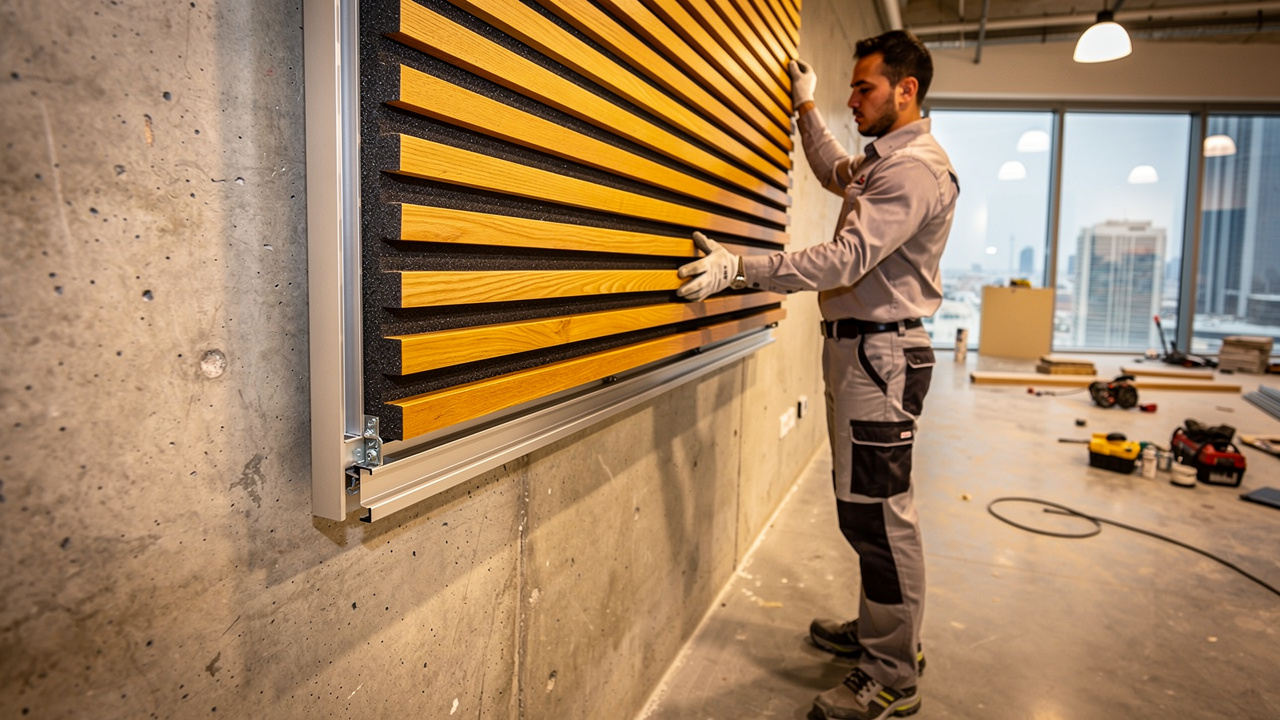
Installation and coverage best practices make the difference between panels that only decorate and panels that actually control acoustics. For Gulf projects, that means getting surface area, air gaps, fixing methods, and fire performance correct from the first fit out. The guidelines below give a reliable starting point for most rooms.
Treat about fifteen to forty percent of the combined wall and ceiling area, depending on use. Smaller, harder rooms such as busy restaurants sit near the higher end of that band, while larger carpeted or furnished rooms need less coverage for the same reverberation goal.
Leave an air gap of roughly twenty five to fifty millimeters behind the acoustic backing wherever construction allows it. That cavity improves performance at lower mid frequencies without changing the visible design; simple timber or metal battens create the stand off from block or drywall.
Use concealed clip systems such as Z clips or aluminum rails for commercial fit outs in Dubai and Abu Dhabi. These fixings keep screws hidden, allow single panels to be removed for access, and increase installation speed. DE Sound supplies compatible mounting hardware details so site teams avoid improvised methods.
Confirm that every decorative wooden acoustic panel holds a fire reaction class that suits UAE Civil Defence requirements, often Class B to EN 13501 1 or an accepted local equivalent. Ask for current certificates before approving any submittal to protect guests, staff, and clients and avoid handover delays.
Site Tip: Label panel backs and shop drawings clearly so maintenance teams can remove and reinstall individual panels without confusion.
Why UAE and GCC Projects Choose DE Sound for Decorative Wooden Acoustic Panels
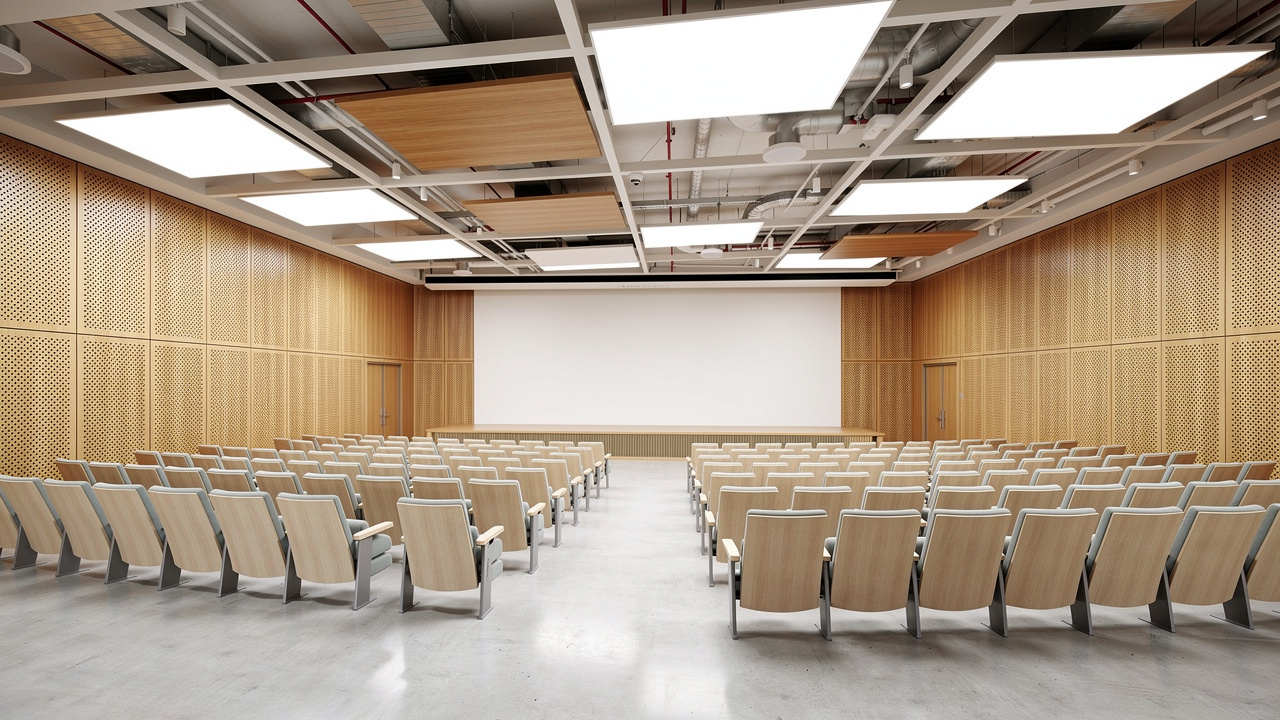
UAE and GCC projects choose DE Sound for decorative wooden acoustic panels because the company combines regional stock, factory direct pricing, and technical support, helping interior designers, contractors, and facility managers deliver reliable Room Acoustics with Decorative Wooden Acoustic Panels on tight programs and budgets.
By working on a wholesale model, DE Sound removes multiple importer and retailer margins that often inflate acoustic material costs in the Gulf. Research from the World Green Building Council links better indoor environmental quality, including acoustics, with productivity gains of up to eleven percent in some office case studies. Bulk pricing, transparent quotations, and consistent SKUs support those gains by making effective acoustic treatment easier to justify across many sites.
All major wooden panel ranges come with independently tested NRC data, fire certificates to EN 13501 1, and VOC information suitable for schemes such as LEED and the WELL Building Standard. This documentation gives consultants and authorities confidence that panels match project specifications and also supports green building efforts under local programs such as Abu Dhabi ESTIDAMA.
DE Sound’s technical team works directly with acoustic consultants, architects, and fit out contractors. They help calculate approximate RT60 values, choose between slatted, perforated, or grooved faces, and set target coverage percentages before drawings are frozen. For complex venues such as ballrooms or auditoria, the team can coordinate with ODEON or EASE simulation outputs from specialist consultants.
Fast delivery across the six GCC countries, coordinated through regional logistics partners, keeps panel shipments aligned with site progress. Because DE Sound also supplies PET panels and stretch fabric systems, teams can compare alternative treatments within a single submittal package and still work with one point of contact.
Putting It All Together
Putting everything together means matching the right panel type, coverage rate, and supplier support for each project. When those three elements align, decorative wooden acoustic panels deliver measurable improvement along with the level of finish expected in Gulf hospitality, corporate, and residential interiors.
Before finalizing any specification, teams should double check performance data, confirm fire ratings, and sketch basic panel layouts for key rooms. With that preparation, it becomes much easier to move from concept design to confident procurement.
Key Takeaways
Key points below keep upcoming projects focused.
Decorative wooden panels control sound and appearance at the same time; slatted, perforated, diffusive, and grooved designs each shape sound differently, so the pattern should match the room use.
Acoustic performance depends more on surface area and correct installation than on brand names; treating roughly fifteen to forty percent of walls and ceilings, with a decent air gap and proper fixings, usually brings reverberation into a comfortable and safe range.
Regional support from DE Sound brings factory direct pricing, certified test data, and layout advice together, shortening lead times and keeping Room Acoustics with Decorative Wooden Acoustic Panels realistic for many project types across the UAE and GCC.
Frequently Asked Questions
These quick answers address common points that appear when teams consider decorative wooden acoustic panels for Gulf projects.
What Is the Difference Between Acoustic Panels and Soundproofing Panels?
Acoustic panels work inside a room to reduce echo and improve clarity, while soundproofing panels stop noise from passing through walls or floors. Decorative wooden acoustic panels mainly absorb and diffuse internal reflections, and when airtight construction is weak they should be combined with separate sound isolation measures.
How Many Wooden Acoustic Panels Do I Need for My Space?
Most rooms perform well when about fifteen to forty percent of total wall and ceiling surface is treated with acoustic panels, but the exact number depends on room size, furnishings, and the reverberation target. DE Sound’s team can review drawings and suggest a project specific panel count.
Are Decorative Wooden Acoustic Panels Suitable for Humid UAE Coastal Environments?
Yes, decorative wooden acoustic panels work well in coastal cities such as Dubai and Abu Dhabi when they use engineered MDF cores with factory applied veneer or laminate; these constructions stay more stable under humidity changes than solid timber, which is prone to movement in Gulf conditions.
Do Wooden Acoustic Panels Comply with UAE Fire Safety Regulations?
Wooden acoustic panels can comply with UAE fire rules when they carry suitable reaction to fire classifications, often Class B under EN 13501 1 or a recognized local standard. DE Sound supplies panels with current independent test reports so consultants and authorities can check compliance quickly.
Can Decorative Wooden Acoustic Panels Be Customized to Match a Specific Interior Design Concept?
Yes, manufacturers offer many veneer species, painted finishes, slot spacings, perforation patterns, and panel sizes to fit specific design concepts, and DE Sound helps teams align these options with brand palettes, joinery finishes, and acoustic targets so the finished space feels coordinated and controlled.
Conclusion
Decorative wooden acoustic panels make it possible to calm noisy rooms without losing the character of timber interiors. When panel type, layout, and installation follow clear acoustic targets, offices, hotels, schools, studios, and homes across the UAE gain clearer, calmer sound that supports comfort and communication.
For teams planning upcoming work, the next step is straightforward: share basic room dimensions, drawings, and project goals with DE Sound, then review suggested panel types, quantities, and finishes. That collaboration keeps Room Acoustics with Decorative Wooden Acoustic Panels on schedule, on budget, and aligned with the design vision for every Gulf project.