
Introduction
Noise complaints in towers and busy mixed-use buildings across the UAE keep rising, especially from hard floors. Many projects still rely on standard foam or felt underlays that do very little for real sound control, so problems stay unsolved. Acoustic underlay gives designers and contractors a practical way to cut noise between floors without changing the structure.
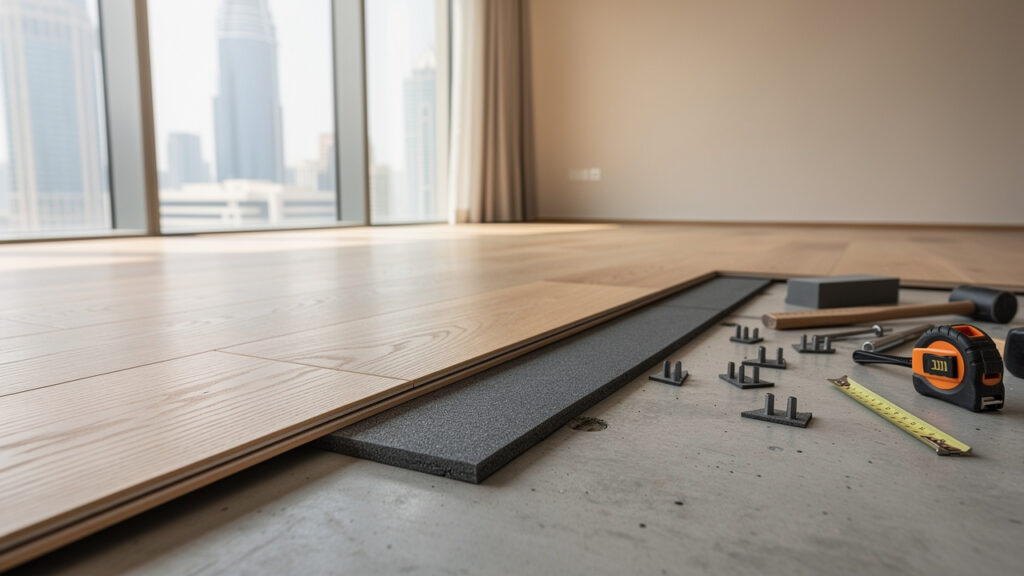
Acoustic underlay is a dense, resilient layer installed under the finished floor that absorbs impact energy and reduces sound transfer. It normally sits between the structural slab and the finished floor, such as laminate, LVT, tile, or engineered wood. The material compresses slightly under load, absorbs vibration from footsteps and movement, and turns that energy into tiny amounts of heat instead of noise.
In this guide, you will see what acoustic underlay is, how it reduces impact and airborne noise, the main material options, how to read sound ratings, and what to check before specifying a product in the Gulf region. You will also see how DE Sound supports projects across the UAE and wider GCC with bulk supply and technical advice.
Ready to choose floor systems that sound as good as they look across Dubai, Abu Dhabi, and beyond? Keep reading to match the right acoustic underlay to your next residential or commercial fit-out.
Key Takeaways
Acoustic underlay vs. standard underlay: Acoustic underlay sits under the finished floor and cuts both impact and some airborne noise, while standard underlay mainly softens the step and adds minor insulation. You need the acoustic version in high-rise apartments, hotels, offices, schools, and studios that sit above other occupied spaces.
Material choice matters: Different materials fit different uses. Rubber suits heavy commercial traffic, foam suits light residential spaces, cork supports green projects, and composite or MLV systems suit hotels and studios. Matching material to traffic, budget, and performance avoids early failures.
Sound ratings guide performance: Sound ratings such as IIC, STC, and Delta IIC show how well a floor build-up controls impact and airborne sound. Thickness, density, subfloor flatness, fire rating, and moisture control matter as much as the acoustic number on the data sheet, which is where DE Sound’s regional expertise helps Gulf projects.
What Is Acoustic Underlay And How Does It Reduce Noise?

Acoustic underlay is a sound-dampening layer installed under floors that reduces noise transfer between rooms and levels. It usually sits between the structural slab and the finished floor, such as laminate, LVT, tile, or engineered wood. The material compresses slightly under load, absorbs vibration from footsteps and movement, and turns that energy into heat instead of noise that travels through the building.
For busy UAE buildings, acoustic underlay mainly targets impact noise. Impact noise comes from footsteps, dropped items, moving chairs, or trolleys that strike a hard floor and send vibration into the structure. In high-rise towers in Dubai and Abu Dhabi, that vibration travels through concrete slabs and arrives as thuds and bangs in the apartments or offices below.
Acoustic underlay also adds some mass and damping, so it can help airborne noise from voices, music, or HVAC systems, especially when dense materials such as recycled rubber or mass-loaded vinyl (MLV) are used. Still, the main airborne control usually comes from the total floor and ceiling build-up, not only the underlay. For this reason, many hotel, office, and school projects in the Gulf combine acoustic underlay above with acoustic ceilings below.
The health angle matters as well. According to the World Health Organization, long-term exposure to environmental noise leads to at least one million healthy life-years lost every year in Western Europe. That kind of data pushes developers, facility managers, and consultants in the GCC to treat acoustic comfort as a design target, not a luxury upgrade.
Key Performance Ratings: IIC, STC, And ΔIIC Explained
Key performance ratings for acoustic underlay, such as IIC, STC, and Delta IIC, describe how a full floor build-up behaves in lab tests. These numbers let you compare products and check if a system will meet your project targets. Without them, underlay choice becomes guesswork.
Impact Insulation Class (IIC) rates how well a floor–ceiling system reduces impact sound from footsteps and similar noise. A bare concrete slab often measures around IIC 25 to 28. With quality acoustic underlay and a suitable floor finish, that assembly can reach IIC values above 60. According to the International Code Council, the International Building Code sets 50 as the minimum IIC between dwelling units, so higher ratings give extra comfort and fewer complaints.
Sound Transmission Class (STC) rates airborne noise control. Underlay only shifts STC a little, yet dense materials still help when combined with ceilings, insulation, and resilient channels.
Delta IIC, sometimes shown as ΔIIC or ΔLw, shows how many points of impact improvement one underlay adds over a reference slab. Products that deliver Delta IIC of 20 or more, confirmed by independent lab tests, fit most demanding commercial and hospitality applications across the UAE.
To keep the three ratings straight, remember:
IIC – how well the whole floor system blocks impact noise (footsteps, dropped items).
STC – how well it blocks airborne noise (speech, TV, music).
Delta IIC – the extra impact performance one underlay adds on top of a reference slab.
Which Type Of Acoustic Underlay Is Right For Your Project?

Choosing the right type of acoustic underlay for a project in the UAE means matching material to use, traffic level, floor finish, and budget. No single product suits a five-star hotel, a school corridor, and a villa bedroom at the same time. The good news is that most needs fall into four clear material families:
Recycled rubber underlays
Give high density, long life, and strong impact noise reduction. They sit under heavy-use floors in hotel corridors, office open spaces, gyms, and university buildings across Dubai and the wider GCC.Foam underlays (PU or EVA)
Provide lighter support under laminates and engineered wood in apartments and villas, where budget and quick fitting often matter more than very high performance.Cork underlay
Adds both acoustic and thermal comfort with a natural material that suits LEED, Estidama, or WELL targets and supports a more sustainable design approach.Composite systems and MLV-based underlays
Combine layers (for example, rubber plus MLV) to reach high IIC and helpful STC in thin profiles. These are common in hotels, studios, and premium commercial spaces that need stronger control of low-frequency noise.
According to tests summarized by the National Research Council Canada, good underlay systems can add roughly 15 to 25 IIC points over a bare slab, which often makes the difference between constant complaints and a quiet room.
Here is a simple comparison to guide fast decisions:
| Material Type | Best Application | Key Strength | Typical Thickness |
|---|---|---|---|
| Recycled rubber | Hotels, offices, schools, gyms, malls | High density and load resistance | 3 to 10 mm |
| Foam PU or EVA | Apartments, villas, light commercial | Low cost and easy handling | 2 to 5 mm |
| Cork | Luxury homes, boutique hotels, green projects | Natural feel and strong thermal value | 2 to 6 mm |
| Composite or MLV | Luxury hotels, studios, boardrooms, premium towers | High IIC and better STC in thin build | 3 to 6 mm |
For studio owners, podcasters, and broadcasters in Dubai Media City or Abu Dhabi, composite systems with MLV over rubber are often the first choice, because they handle low-frequency thumps that microphones pick up easily. For standard apartments, a good-quality foam or thin rubber underlay under LVT usually strikes the right balance between performance and cost. DE Sound helps specifiers compare lab reports and choose between these families based on real Gulf projects rather than generic brochures.
Key Factors To Consider When Specifying Acoustic Underlay In The UAE

Key factors for specifying acoustic underlay in the UAE include floor finish, traffic, subfloor quality, moisture, fire performance, and available height. Getting these points clear early prevents last-minute changes, delays, and extra cost. Each factor links back to real project risks that interior designers, contractors, and facility managers face across the Gulf.
Flooring Type Compatibility
Each floor finish reacts differently over underlay:Laminate and engineered wood need stable, resilient support so joints do not open.
LVT and sheet vinyl often need underlays that work with full-spread adhesive and resist indentation.
Tile or stone may require dense rubber or composite boards that limit deflection.
Always check the floor manufacturer’s instructions and match them with the underlay data sheet before you place an order.
Traffic And Load Profile
Commercial spaces in Dubai malls, offices, and schools carry rolling loads, luggage, and constant foot traffic. Foam underlays designed for bedrooms often compress under this stress and lose performance. Rubber and composite systems hold their thickness and acoustic value for much longer. For light-use homes or hotel suites with carpet or wood, a good residential-grade underlay can still perform well at a lower cost.Subfloor Condition
Acoustic underlay works best on clean, flat, dry slabs. Large highs or lows create voids under the material, which can lead to hollow sounds, cracked floor boards, or tile issues. Most manufacturers want flatness within about 3 mm over 2 m, similar to EN 13318 guidelines. Grinding high spots and patching low spots before you roll out underlay protects both acoustic performance and long-term durability.Moisture And Climate Conditions
Ground floors, podium decks, bathrooms, and pool areas across the GCC can all show moisture. In those spaces, closed-cell rubber or EVA foam with an integrated vapor barrier make more sense than open-cell foam or unprotected cork. In the hot Gulf climate, you also want underlays that tolerate temperature swings without shrinking or curling, which DE Sound checks when it selects materials for regional stock.Fire Rating And Code Compliance
Fire performance is a key part of any floor build in the UAE, especially in hotels, schools, and high-rise residential towers. Underlays normally need tested fire behavior, often Class B or better under EN 13501-1, to be accepted. The International Building Code also sets minimum IIC and STC ratings of 50 between dwelling units, as noted by the International Code Council, which pushes teams toward tested acoustic systems rather than generic foam rolls.Height Constraints In Fit-Out Refurbishments
Many refurbishments in Dubai’s older towers and hotels cannot raise finished levels by much. Doors, thresholds, and joinery already sit at fixed heights. In these cases, thin yet dense composite underlays in the 3 to 5 mm range give the best balance between acoustic benefit and build-up height. DE Sound often helps project teams compare options so they can keep ceiling heights while still hitting IIC and STC targets.
According to research from the University of Sydney, more than half of workers in open-plan offices rank noise and lack of privacy as their top frustrations. That kind of feedback shows why careful acoustic underlay specification matters so much in Gulf office projects.
Tip: “Start by defining your noise targets and floor build-up height, then choose the underlay. Doing it the other way around usually adds cost on site.”
— DE Sound technical team
Why UAE Contractors And Designers Source Acoustic Underlay From DE Sound

UAE contractors and designers source acoustic underlay from DE Sound because they need tested materials, clear prices, and fast deliveries across multiple projects. Generic overseas suppliers may offer catalog products, yet they often cannot support Gulf site conditions or program pressures. DE Sound focuses its range and service on the needs of clients in the UAE and wider GCC.
DE Sound supplies recycled rubber, foam, cork, and composite acoustic underlay in bulk at factory-direct prices. That model removes retail markups and helps developers control flooring costs across hundreds of apartments or hotel rooms. All products come with acoustic reports, fire test data, and clear installation notes, so consultants and contractors can document compliance for authorities and operators.
“On multi-floor projects across Dubai and Abu Dhabi, real acoustic savings come from choosing the right underlay early, not from cutting it at the last minute.”
— DE Sound technical team
The company also provides free project-specific consultation. Interior designers can send drawings, floor finishes, and target IIC or STC values, and receive a short list of suitable products instead of trawling through dozens of unrelated options. Facility managers in hotels, schools, or corporate offices gain a single partner that also supplies wall panels, ceiling baffles, and acoustic barriers, so ordering and logistics stay simple.
“Contractors across the GCC rely on DE Sound for acoustic underlay that arrives on time, performs as tested, and supports smooth handover.”
— DE Sound technical team
With stock positioned for fast delivery across six GCC countries, DE Sound helps sites avoid delays linked to overseas shipping or customs. That reliability, combined with transparent pricing and regional expertise, explains why many flooring and fit-out teams treat DE Sound as their default acoustic underlay partner.
Putting It All Together

Putting acoustic underlay decisions together for a Gulf project means linking material type, sound ratings, and site conditions into one clear specification. Rubber, foam, cork, or composite products all have a place, as long as their thickness, density, and test data fit the building’s use and code needs. Labs provide IIC, STC, and Delta IIC numbers, yet real success also depends on subfloor preparation and careful installation.
For high-rise housing, hotels, offices, schools, and studios across the UAE, the right acoustic underlay turns hard floors from a noise source into a quiet, solid surface. Working with a specialist supplier such as DE Sound helps project teams reach that goal with less risk and less guesswork.
Conclusion
Choosing the right acoustic underlay for residential and commercial floors in the UAE is a technical decision that has clear human results. Better impact control means fewer late-night complaints, calmer classrooms, more focused offices, and cleaner studio recordings. The wrong choice can leave beautiful interiors that still sound harsh, even when every finish looks premium.
A smart approach starts with clear performance targets, such as IIC and STC values that meet or exceed building code minimums. From there, designers and contractors match floor finishes to suitable underlay materials, check data sheets for Delta IIC, fire rating, and moisture behavior, and confirm that build-up heights fit doors and thresholds. Installation teams then treat underlay as part of the acoustic system, not as a thin pad to hide slab defects.
DE Sound supports every step of this process for projects across Dubai, Abu Dhabi, Sharjah, and the wider GCC. If you are planning apartments, a hotel, a school, or a studio, a short call or email can turn complex acoustic questions into a clear, documented underlay package. Reach out to DE Sound for wholesale pricing, certified products, and practical guidance on your next acoustic underlay requirement.
Frequently Asked Questions
Question: What Is The Difference Between Acoustic Underlay And Standard Underlay?
Acoustic underlay is designed to reduce impact and some airborne noise, while standard underlay mainly adds comfort and minor insulation. Acoustic products use specific density and resilience to absorb vibration and come with lab-tested IIC, STC, and Delta IIC ratings. Standard underlay rarely carries these ratings and usually cannot meet acoustic targets in UAE towers and hotels.
Question: Which Acoustic Underlay Material Is Best For A Commercial Fit-Out In The UAE?
Recycled rubber and composite multi-layer acoustic underlay suit most commercial fit-outs in the UAE. They handle heavy foot traffic, rolling loads, and furniture movement without permanent compression and deliver strong Delta IIC improvements over bare slabs. For luxury hotels, boardrooms, and studios, composite systems that include mass-loaded vinyl give higher IIC and better airborne control. DE Sound helps match products to each project.
Question: How Thick Should Acoustic Underlay Be For A Residential Apartment In Dubai?
For most residential apartments in Dubai, acoustic underlay thickness between 3 and 6 mm works well. The right choice depends on density, floor finish, and door or threshold heights. A thin but dense rubber or composite underlay can outperform a thicker, soft foam product. DE Sound can review drawings and recommend the best thickness and material for each apartment floor build-up.
Question: Does Acoustic Underlay Help With Airborne Noise As Well As Footstep Noise?
Yes, acoustic underlay helps airborne noise, but its main strength is impact noise such as footsteps. Dense rubber or composite underlays add mass and damping, which slightly improves STC ratings by making floors harder to set in motion. For strong airborne control, designers usually combine acoustic underlay with resilient ceilings, insulation, and sealed partitions as part of a complete acoustic design.
Question: Is Acoustic Underlay Required Under All Flooring Types In UAE Buildings?
Acoustic underlay is strongly recommended under hard floor finishes such as tile, LVT, engineered wood, laminate, and polished concrete in multi-story UAE buildings. These surfaces reflect impact noise and can cause serious disturbance without an isolation layer. Carpet absorbs some impact noise on its own, yet many hotels and offices still add acoustic underlay to reach target IIC values and meet code or operator requirements.
Question: Can Acoustic Underlay Be Used With Underfloor Heating Systems?
Yes, certain acoustic underlays work well with underfloor heating systems in UAE hotels and luxury homes. These products have low thermal resistance, often shown as a Tog value, so heat can pass through without large energy loss. Standard underlays with high thermal resistance can slow heating response, so always select an acoustic underlay that the manufacturer rates as suitable for underfloor heating.