

Africa’s building boom brings new hotels, offices, and schools, but also louder, hotter, more resource-hungry interiors. Hard surfaces, open volumes, and rising carbon targets put real pressure on every project team.
PET acoustic panels turn recycled plastic into quiet, comfortable surfaces for walls and ceilings. They cut reverberation, clean up speech, and support green building goals in a single material. This article explains what PET acoustic panels are, why they suit African interiors so well, how they support LEED and Green Star targets, where they work best, and how DE Sound supplies them at wholesale scale.
The next sections show how this one material links acoustic comfort, bold design, and sustainability for projects across the continent.
Key Takeaways
PET acoustic panels use recycled PET fibers to absorb sound. They replace noisy hard surfaces with calm, controlled rooms and help projects meet acoustic targets without toxic materials.
PET acoustic panels manage noise, echo, and speech clarity using fibers made from recycled plastic bottles. They turn post-consumer waste into a practical interior finish.
Their high recycled content, low VOC profile, and recyclability support LEED, BREEAM, and Green Star credits. They fit ESG-focused specifications and help building owners report measurable progress.
DE Sound supplies tested PET acoustic panels at factory-direct prices and backs them with free technical guidance. This combination removes cost and knowledge barriers for African projects.
What Are PET Acoustic Panels And Why Do They Matter For African Interiors?
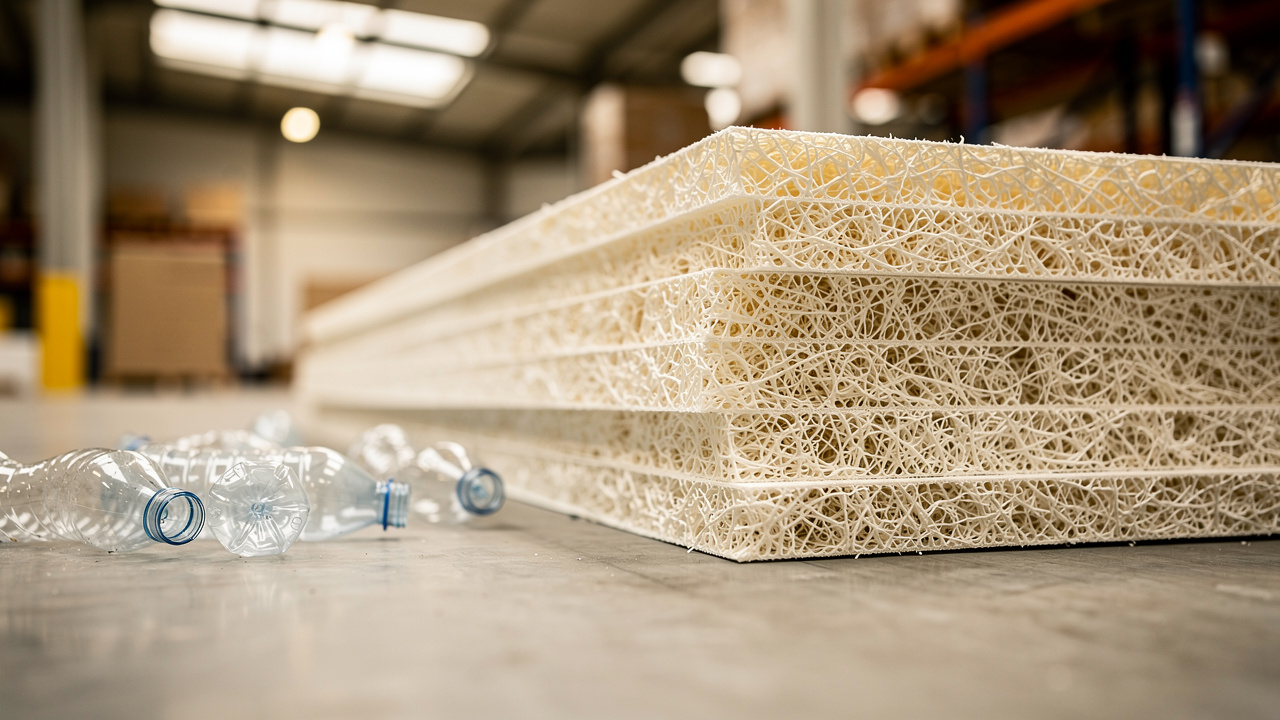
PET acoustic panels are rigid or semi-rigid boards made from recycled polyethylene terephthalate (PET) fibers that absorb sound instead of reflecting it. In African interiors with lots of concrete, glass, and tile, these panels matter because they calm noisy rooms while lowering plastic waste and improving indoor air quality.
Manufacturers typically follow a simple, repeatable process:
Collect post-consumer plastic bottles and sort them by polymer type.
Clean and shred the bottles into flakes.
Melt and draw those flakes into polyester fibers.
Layer the fibers, then apply controlled heat and pressure to fuse them into a dense, stable mat without added formaldehyde or hazardous binders.
The result is a porous material with countless tiny air pockets where sound energy turns into a trace amount of heat instead of bouncing back into the room.
Because the panels are polyester, they resist moisture, mold, and mildew. That is especially helpful in coastal cities such as Durban, Lagos, or Accra, where humidity and salt air can damage traditional fiber products. Unlike fiberglass, installers can cut and handle PET acoustic panels without itchy dust, and the panels release almost no VOCs into the space once installed. According to the World Green Building Council, buildings cause about 39 percent of global energy-related carbon emissions — a figure consistent with research tracking Global daily CO2 emissions over decades — so low-emission interior materials are now a serious design priority.
As many acoustic consultants like to say, “Hard surfaces reflect, soft surfaces absorb — good rooms use the right mix of both.”
African cities are growing fast, and many new buildings favor hard finishes and large open areas. This combination creates strong reverberation that hurts concentration in offices and speech clarity in classrooms and clinics. PET acoustic panels help control mid and high frequencies in these spaces, and thicker boards can also support lower frequencies in studios and home cinemas. When panels cover 25 to 40 percent of key wall and ceiling surfaces, reverberation times can drop from more than 1.5 seconds to the 0.4 to 0.6 second range recommended for offices and learning spaces by professional bodies such as the Acoustical Society of America.
DE Sound focuses on supplying PET acoustic panels in bulk for exactly these types of projects. By pairing tested products with practical acoustic advice, the company helps African designers and contractors specify material that fits both performance needs and sustainability goals.
How PET Acoustic Panels Support Green Building Goals In Africa
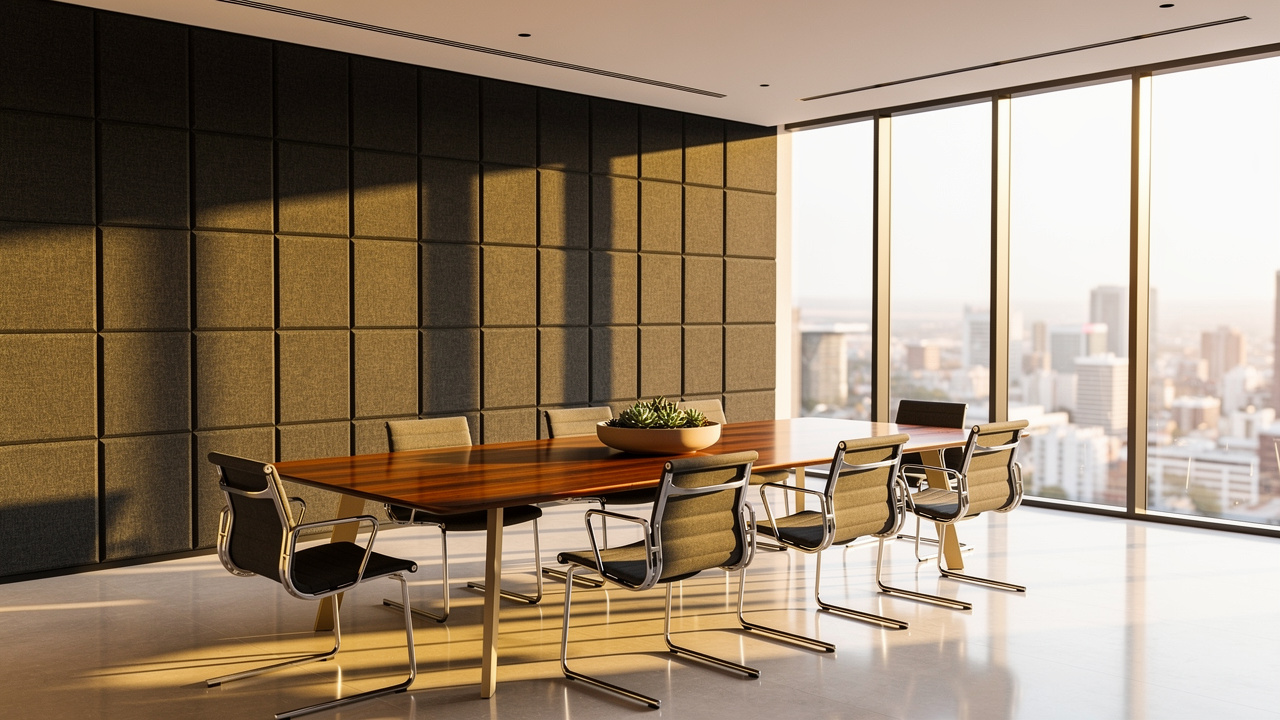
PET acoustic panels support green building goals in Africa by combining high recycled content, low emissions, and recyclability at end of life. This makes them a natural match for LEED, BREEAM, Green Star South Africa, and other regional frameworks that reward responsible material choices.
Each standard 2400 by 1200 millimeter PET acoustic panel can contain the equivalent of roughly 60 to 80 recycled plastic bottles, depending on thickness and density. Many products reach 60 to 100 percent recycled PET content, helping projects increase the share of recycled materials that rating tools require — a shift that also aligns with evidence that Renewable Energy and Carbon intensity are closely linked across global economies. According to the U.S. Environmental Protection Agency, PET beverage bottles are among the most commonly recycled plastics worldwide, which gives this material a steady input stream for building products.
Unlike some foam and fiberglass, PET acoustic panels emit almost no VOCs and contain no formaldehyde. That supports indoor environmental quality credits and protects occupants who spend long hours in offices, classrooms, and clinics. At the end of their service life, panels can go back into polyester recycling loops instead of landfill, which supports circular economy goals promoted by the International Well Building Institute and similar bodies.
Here is how PET acoustic panels compare with common acoustic materials on sustainability aspects:
| Material | Typical Recycled Content | VOC / Formaldehyde Profile | End-Of-Life Option |
|---|---|---|---|
| PET acoustic panels | High, often 60–100% | Very low VOC, no formaldehyde | Fully recyclable as polyester |
| Fiberglass boards | Low to medium | Can contain binders and formaldehyde | Often landfill |
| PU acoustic foam | Very low | Can release VOCs over time | Difficult to recycle |
| Mineral wool panels | Low to medium | May use chemical binders | Limited recycling routes |
Across Africa, more corporate and public clients now publish ESG reports, reflecting a global trend driven in part by country-level commitments to reach Carbon emission peaks in line with national climate strategies. A recent global survey from KPMG shows that a clear majority of large companies disclose sustainability performance, which places fresh pressure on local subsidiaries and partners. When a hotel group, bank, or university in Nairobi or Johannesburg specifies PET acoustic panels, that decision gives the project measurable recycled content, acoustic comfort, and indoor air quality outcomes to report.
One sustainability officer for a regional property group summed it up neatly: “If a product cannot show its recycled content and VOC test results, it does not go into our buildings.”
DE Sound supports these green building targets by supplying PET acoustic panels with documented recycled content, VOC test data, and fire performance reports. This documentation helps project teams assemble LEED, BREEAM, or Green Star South Africa submissions without chasing manufacturers across multiple time zones.
For specifiers, a simple checklist helps align PET acoustic panels with green rating tools:
Confirm recycled content percentage and request third-party declarations.
Ask for VOC emission reports and formaldehyde-free confirmation.
Check fire classification against local building regulations.
Keep all certificates and data sheets in the project’s green building file for audits.
Where PET Acoustic Panels Deliver The Most Impact: Key Commercial Applications

PET acoustic panels deliver the most impact in African projects where open spaces, hard surfaces, and high occupancy levels create serious noise problems. Offices, hotels, schools, healthcare facilities, and studios all benefit when reverberation falls and speech becomes easier to hear.
In open-plan corporate offices, glass, tile, and concrete reflect every phone call and meeting back into the workspace. PET acoustic panels used as ceiling baffles, wall cladding, or desk dividers absorb these reflections and can bring reverberation into the 0.4 to 0.6 second range suitable for focused work. Research collected by the World Green Building Council links better indoor environments, including acoustics, with productivity gains of up to 11 percent, which makes acoustic treatment a sound business decision.
Key commercial applications include:
Corporate offices and coworking spaces. PET acoustic panels on key walls and ceilings calm busy floors and allow people to hear speech clearly without shouting, a performance outcome supported by Table 3 Reverberation time data showing how material choices directly affect speech intelligibility across different room types. Panels can double as colorful branding features in reception areas and meeting rooms. With several thickness options, designers can handle both light background noise and more demanding boardroom acoustics.
Hotels, restaurants, and hospitality venues. Guests dislike dining or sleeping in noisy spaces, and online reviews reflect that. PET acoustic panels in lobbies, corridors, dining areas, and conference rooms reduce clatter and echo while matching brand colors. Custom-cut shapes create feature ceilings that support both a quiet atmosphere and a memorable interior for hotels from Cape Town to Kigali.
Schools, universities, and training centers. Classroom speech clarity has a strong effect on learning results, especially for second-language students. PET acoustic panels create calmer rooms where teachers do not have to raise their voices and students hear every word. Impact-resistant surfaces and bright colors suit corridors, libraries, and multi-purpose halls that see daily wear.
Healthcare and wellness facilities. Clinics, hospitals, and wellness studios need privacy and calm, yet many rely on hard finishes that reflect sound. PET acoustic panels provide sound absorption with a non-fibrous, wipeable surface, which is well suited to healthcare hygiene standards cited by the World Health Organization. Waiting areas, wards, gyms, and therapy rooms all gain from lower noise levels.
Studios, podcast booths, and content spaces. African creators on platforms such as YouTube and Spotify now want professional sound without complex builds. Thicker PET acoustic panels on first reflection points remove flutter echo and sharpen recordings, while corner placement supports bass control. Clean lines and color options keep studios camera-ready without extra finishes.
Design versatility strengthens the commercial case for PET acoustic panels across all these sectors. Panels come as standard boards, slotted baffles, tiles, and custom-cut geometric patterns, in 30 to 60 or more colors and thicknesses from roughly 12 to 50 millimeters. That flexibility lets interior designers and fit-out contractors deliver both bold feature walls and more modest back-of-house treatments using the same core material.
A helpful design tip: start by treating ceilings and the walls people face most often. These surfaces usually give the fastest improvement in perceived noise and speech clarity.
Why DE Sound Is The Right Wholesale Partner For PET Acoustic Panels In Africa

DE Sound is the right wholesale partner for PET acoustic panels because the company combines factory-direct pricing, tested products, and practical acoustic guidance. That mix removes common barriers that stop sustainable materials from entering real projects.
Many teams still assume green materials cost far more than standard options. DE Sound works directly with factories, so interior designers, contractors, and facility managers receive PET acoustic panels at wholesale rates instead of marked-up retail prices. This pricing structure makes it easier for African projects to switch from basic foam or fiberglass to a recycled material with better handling, appearance, and documentation.
Product confidence is just as important as price, particularly given emerging research on the Multifunctional performance assessment of waste-based wall panels that evaluates acoustic, thermal, and structural efficiency together — the kind of holistic data DE Sound makes available to specifiers. DE Sound supplies PET acoustic panels with verified NRC (Noise Reduction Coefficient) values, recycled content statements, and fire test reports suitable for commercial codes. This is valuable for clients working toward LEED, BREEAM, or Green Star South Africa points, because every panel specification must sit on reliable data. Clear documentation also supports health and safety reviews for schools, hospitals, and large corporate campuses.
Key aspects of the DE Sound wholesale model include:
Factory-direct wholesale model. DE Sound sources PET acoustic panels straight from manufacturing partners, which cuts out extra distributors. That keeps prices predictable for long project programs and multi-site rollouts. It also helps large African clients standardize acoustic materials across regional portfolios.
Technical support from acoustic specialists. Many teams know they have an acoustic problem but are unsure how much coverage or what thickness to use. DE Sound’s consultants review drawings or room descriptions and suggest thickness, density, coverage percentage, and placement that fit real targets. This support helps projects invest in the right quantity instead of guessing.
Reliable supply and color consistency. Large hotels, universities, and office parks often need thousands of square meters of PET acoustic panels over several phases. DE Sound’s wholesale model, built around fast regional delivery, scales to African orders while keeping color batches consistent and stock secure. Procurement teams receive clear lead times and project-based pricing agreements instead of vague promises.
For project teams, working with DE Sound usually follows three simple steps:
Share room dimensions, finishes, and project goals with the DE Sound team.
Receive layout ideas, coverage recommendations, and budget rates.
Confirm colors and thicknesses, then schedule deliveries to match site progress.
According to the Green Building Council South Africa, certified green building space in the country has grown rapidly over the past decade. That growth pattern is now spreading across the continent. With its focus on sustainable acoustic materials at scale, DE Sound is ready to partner with African specifiers who want interiors that sound better and perform better for the planet.
The Future Belongs To Interiors That Perform And Protect The Planet

The future of African interiors belongs to spaces that sound good, look good, and tread lightly on the environment. PET acoustic panels sit at the center of that shift by turning recycled plastic into quiet, colorful, long-lasting surfaces.
As cities across the continent keep building hotels, offices, schools, studios, and clinics, decision-makers need materials that handle both acoustic comfort and ESG commitments. PET acoustic panels answer that need, especially when backed by a supplier that understands wholesale logistics and acoustic science.
Interior designers, fit-out contractors, facility managers, and procurement officers can contact DE Sound for samples, bulk pricing, or a free acoustic consultation that aligns PET acoustic panels with their next African project.
Frequently Asked Questions
This section answers common questions project teams ask when they look at PET acoustic panels for African schools, hospitals, offices, and other commercial spaces. Each reply gives a direct, practical response that stands on its own.
Are PET Acoustic Panels Safe For Use In Schools And Healthcare Facilities In Africa?
Yes, PET acoustic panels are safe for schools and healthcare facilities across Africa when sourced from reputable manufacturers. Quality panels:
Contain no formaldehyde.
Release almost no VOCs.
Do not shed itchy fibers.
Many products meet Class A or Class B fire performance standards under international tests, which suits strict public-building requirements.
What Thickness Of PET Acoustic Panel Should I Specify For An Open Plan Office?
Most open-plan offices perform well with PET acoustic panels between 12 and 25 millimeters thick. This range typically reaches NRC values around 0.75 or higher for speech frequencies. For call centers or very noisy floors, 25 millimeter panels and partial air gaps can help with lower frequencies and overall comfort.
Can PET Acoustic Panels Contribute To LEED Or Green Star Certification In African Projects?
Yes, PET acoustic panels can support LEED, BREEAM, and Green Star South Africa credits. Their recycled content helps material sourcing points, and their low VOC profile supports indoor environmental quality credits. When correctly specified, they also assist acoustic performance credits. DE Sound provides the documentation needed for these submissions.
How Do I Source PET Acoustic Panels In Bulk For A Large Commercial Project In Africa?
The simplest path is to source PET acoustic panels through a wholesale supplier such as DE Sound. The team offers factory-direct pricing, project-based agreements, and clear lead times for large volumes. Free expert consultation and detailed technical data sheets support both design decisions and procurement approvals.
How Long Do PET Acoustic Panels Last Compared To Foam Or Fiberglass Alternatives?
PET acoustic panels usually last as long as the interior itself. The polyester fiber matrix resists sagging, crumbling, and moisture damage, even in humid climates. In contrast, many foam products discolor and break down, and fiberglass raises handling concerns. Over a full lifecycle, PET panels give facility managers better value and fewer replacement headaches.