
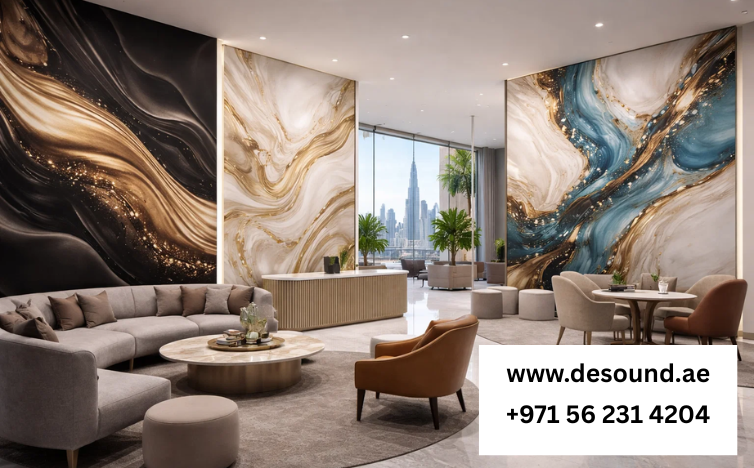
The first time I walked into a DIFC office that had stretch fabric walls installed floor to ceiling, I genuinely stopped mid-conversation. Not because of how it looked — though it looked sharp — but because of how it felt. The noise just… died. The hum of the open floor plan, the keyboard clicks, the glass-wall echo that plagues nearly every modern Dubai office I’d ever visited — gone.
That was the moment I stopped seeing stretch fabric wall systems as a “design trend” and started understanding them as a serious acoustic and architectural decision. And here in Dubai, where the commercial real estate market is exploding and every business wants to look premium without sounding like a construction site, they’ve become almost standard.
So why exactly are stretch fabric walls showing up in Dubai offices everywhere you look? Let me tell you what I’ve found.
Dubai Offices Have a Noise Problem Nobody Talks About
Here’s the thing most interior designers won’t say out loud: the glass-and-concrete aesthetic that defines Dubai’s corporate spaces is acoustically terrible. Hard floors, exposed ceilings, floor-to-ceiling glass partitions — all of it reflects sound rather than absorbing it. The result is a reverberation problem that tanks productivity and makes video calls a nightmare.
A 2019 study published in the Journal of Environmental Psychology found that uncontrolled office noise reduces cognitive performance by up to 66%. No, really. Two thirds of your thinking capacity, gone — just from background noise. I’ve seen this play out firsthand in open-plan offices in Business Bay where employees literally wear noise-cancelling headphones all day just to concentrate.
directly address this. The system works by stretching acoustic fabric over a lightweight aluminum or plastic track framework, with sound-absorbing backing materials — typically foam or fiberglass — installed behind. That combination doesn’t just look seamless; it pulls sound energy out of the room before it has a chance to bounce around.
The Setup That Makes Architects Actually Love Them
What surprised me when I first looked into this seriously is how much flexibility the track system offers compared to rigid acoustic panels. Traditional wall panels are fixed. You cut them, mount them, paint around them, and if something changes — a rebrand, a renovation — you’re back to square one.
Stretch fabric wall track systems work differently. The aluminum track gets mounted to the wall once. After that, the fabric itself can be removed and replaced without touching the structure. Want to change the color for a client event? Done. Need to access the wiring or utilities behind the wall? Pull the fabric, handle it, re-stretch. From what I’ve seen working with acoustic fit-out specialists in the UAE, this modularity is one of the biggest reasons architects and project managers specify this system in commercial builds.
And in Dubai, where office refits happen more frequently than anywhere else I’ve worked, that’s not a small thing. It’s a serious cost-saving feature hiding inside a design decision.
Why “It Looks Premium” Is Actually a Technical Achievement
Look — I’m not dismissing aesthetics. Dubai’s corporate culture places immense value on first impressions. When a client walks into your conference room, the walls are speaking before anyone opens their mouth.
Stretch fabric walls deliver a genuinely premium finish that other acoustic treatments can’t match at the same price point. There are no visible seams, no screw heads, no uneven edges. The fabric surface is perfectly smooth and taut, almost like a high-end exhibition display. You can spec them in hundreds of fabric options — from matte neutrals to bold branded colors — which means they can be built into a corporate identity rather than just bolted onto it.
According to industry data from the global acoustic panels market, fabric-wrapped acoustic wall systems now account for a significant share of commercial acoustic fit-outs across the GCC, with demand accelerating post-2020 as hybrid workplaces pushed businesses to reconsider how their spaces actually function.
Conference Rooms Are Where the Difference Is Most Obvious
Maine khud dekha hai ki the biggest transformation stretch fabric walls deliver is in meeting rooms. If you’ve ever been in a Dubai conference room where voices echo off glass walls, you know exactly what I mean. It’s the kind of environment where people unconsciously start speaking louder to compensate, which creates more echo, which creates more noise. A feedback loop of bad acoustics.
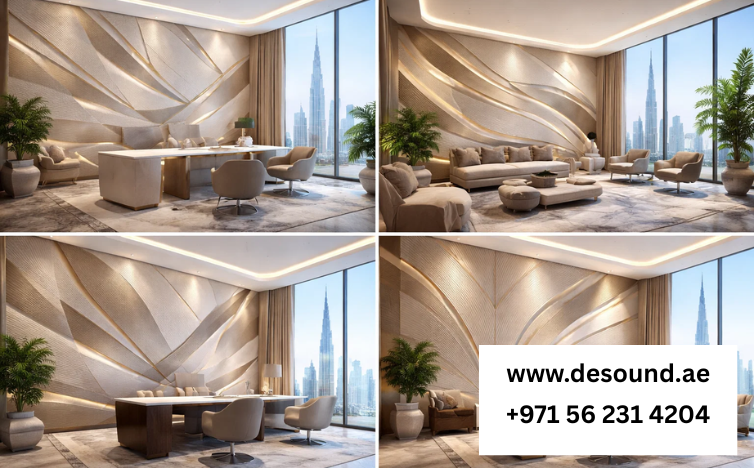
When stretch fabric panels line even two walls of a conference room — ideally the walls parallel to each other — that loop breaks. Speech clarity improves dramatically. Video calls become crisp. The room starts working for the conversation instead of against it.
A real example: a law firm in Jumeirah Lake Towers installed stretch fabric wall track systems across their three main meeting rooms after client feedback consistently mentioned the rooms felt “chaotic” during consultations. Within weeks, they reported measurably shorter meeting times. Calmer space, clearer thinking, faster decisions. That’s not marketing language — that’s acoustic physics doing its job.
What Sets a Good Install Apart From a Mediocre One
This is where a lot of people get burned. Stretch fabric walls are not a DIY product. The track alignment, the fabric tension, the acoustic backing selection — every one of those variables affects the final result. An incorrectly tensioned fabric shows ripples. Misaligned track produces gaps. Wrong backing material and you’re paying for aesthetics with zero acoustic benefit.
From what I’ve seen, the businesses that get the best results are the ones that work with specialists who understand both the acoustic engineering side and the fit-out execution. In the UAE market, companies like De Sound have built their reputation specifically around this — their stretch fabric wall track services focus on getting the technical side right, not just the surface appearance. The difference between a properly installed system and a rushed one is visible, and audible.
It’s Not Just Offices Anymore
Honestly, once you start noticing stretch fabric walls, you see them everywhere. Museum galleries in Dubai use them because they protect art from sound vibration and look gallery-appropriate. Hospitality venues spec them because they soften ambient noise without making a space feel dead. Hospitals, lecture halls, high-end gyms — any space where acoustics matter and appearance matters equally.
But the corporate office market remains the driving force in Dubai specifically. The city added over 2.5 million square meters of commercial office space in the last five years according to JLL’s UAE Office Market reports, and a growing share of those builds are specifying acoustic treatment from day one rather than retrofitting it after complaints start rolling in.
That shift in mindset — acoustic design as a foundational decision, not an afterthought — is probably the single biggest reason stretch fabric walls have gone from a niche product to a standard fixture in Dubai’s better commercial spaces.
Call us: Contact DeSound Soundproofing Expert in Dubai For Soundproofing: +971 56 231 4204
The Question You Should Be Asking Before Your Next Fit-Out
If you’re planning or refitting an office in Dubai and you haven’t asked your interior designer “what are we doing about acoustics?” — ask it now. Before the floor goes in. Before the glass partitions are ordered. Because adding acoustic treatment after a fit-out always costs more and looks like an afterthought, because it is one.
Stretch fabric wall track systems work best when they’re planned into a space, not retrofitted into one. And when they’re done right, they don’t just solve a noise problem. They make the entire office feel intentional, calm, and built for the people who actually work in it.