
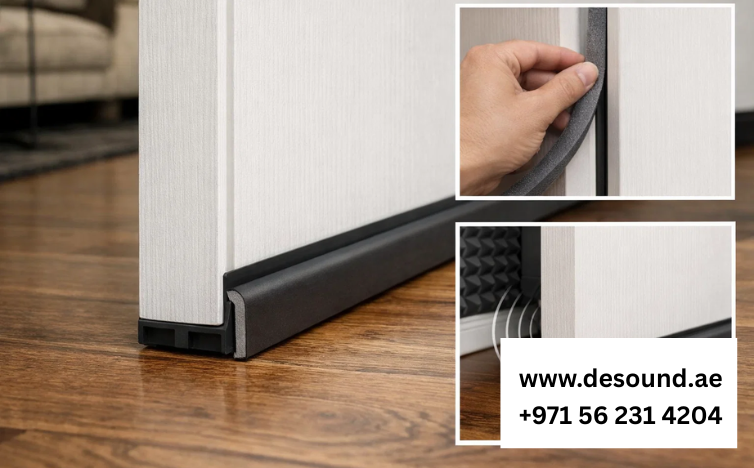
Noise pollution is one of the most common challenges in residential, commercial, and studio environments. From hallway conversations and traffic sounds to office chatter and mechanical noise, unwanted sound can easily pass through gaps you might not even notice. One of the simplest and most affordable soundproofing solution options available today is the installation of door seals.
At Desound, we provide specialized acoustic services and high-performance door sealing systems that significantly improve noise isolation without the need for costly structural changes. If you are looking for a practical, cost-effective method to reduce sound leakage, door seals may be exactly what you are missing.
Understanding How Sound Leaks Through Doors
Before discussing solutions, it is important to understand the problem. Sound travels through air, and even the smallest gap around a door can allow significant noise transfer. The typical weak points include:
- The gap under the door
- The perimeter gap between door and frame
- The keyhole and hardware openings
- Poorly fitted door frames
Even a solid-core door cannot perform effectively if air gaps are present. In acoustic engineering, this is known as flanking transmission through air paths. When air passes through, sound passes through as well.
This is why sealing these gaps is often more impactful than upgrading the door itself.
Why Door Seals Are the Most Affordable Soundproofing Solution
When comparing different soundproofing techniques, such as double drywall systems, acoustic panels, resilient channels, or structural modifications, costs can escalate quickly. These methods are effective but require labor, materials, and sometimes professional construction.
In contrast, door seals offer:
- Low material cost
- Minimal installation time
- No major renovation
- Immediate performance improvement
Because sound leakage often occurs primarily through door gaps, addressing these openings can dramatically improve overall room sound isolation at a fraction of the price. This makes door seals the most affordable soundproofing solution for many environments.
The return on investment is particularly high in offices, clinics, meeting rooms, studios, and apartments where upgrading walls may not be feasible.
How Acoustic Door Seals Work
Acoustic door seals function by eliminating air gaps around the door perimeter and bottom. They create an airtight closure when the door is shut. Since sound travels through air, blocking airflow significantly reduces noise transmission.
High-quality systems, such as those offered by Desound, include:
- Perimeter compression seals
- Automatic drop-down door bottom seals
- Threshold sealing systems
These components work together to form a continuous acoustic barrier. When properly installed, they improve the Sound Transmission Class (STC) performance of a door assembly.
Our acoustic door seal solutions are specifically engineered for effective noise control across residential and commercial applications. You can explore our product details here: https://desound.ae/products/acoustic-door-seal/
Key Benefits of Installing Door Seals
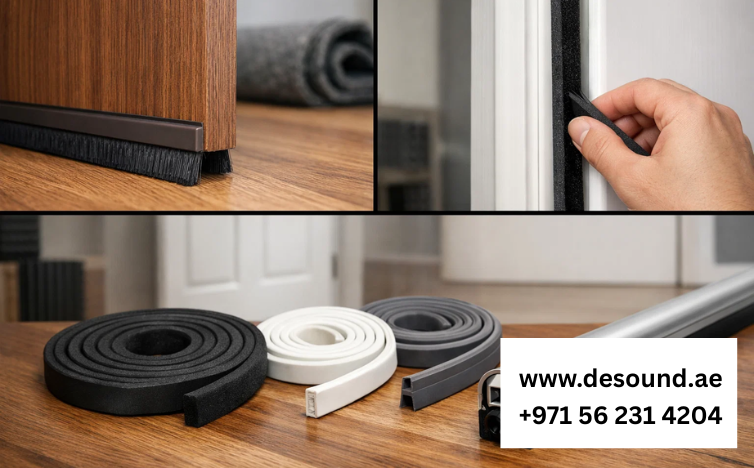
1. Cost-Effective Noise Control
The primary advantage of choosing door seals is affordability. Compared to structural soundproofing upgrades, seals require minimal materials and installation effort. This makes them ideal for budget-conscious projects that still demand measurable acoustic improvement.
2. Quick and Non-Invasive Installation
Door seals can typically be installed without altering walls or ceilings. There is no need for demolition or reconstruction. For tenants or leased commercial spaces, this is particularly valuable.
3. Energy Efficiency Improvement
In addition to sound control, door seals help prevent air leakage. This improves HVAC efficiency, reduces energy costs, and enhances indoor comfort. You gain both acoustic and thermal benefits from a single solution.
4. Improved Privacy
In offices, medical facilities, and consultation rooms, privacy is critical. Even small sound leaks can compromise confidentiality. Properly sealed doors enhance speech privacy and reduce intelligibility of conversations outside the room.
Ideal Applications for Door Seals
Door seals are suitable for a wide range of environments, including:
- Corporate offices and boardrooms
- Recording studios and rehearsal rooms
- Healthcare facilities
- Educational institutions
- Residential apartments
- Hotels and hospitality spaces
In many of these environments, full structural soundproofing may not be practical. However, upgrading door seals is simple and highly effective.
At Desound, our acoustic services are tailored to match each project’s acoustic requirements, ensuring optimal performance without unnecessary expense.
Why Many People Overlook Door Seals
Despite their effectiveness, door seals are often overlooked because they seem too simple to be impactful. Many assume that only thick walls or expensive acoustic panels can significantly reduce noise.
However, in professional acoustic assessments, door gaps are frequently identified as primary failure points in otherwise well-constructed spaces. Even high-STC walls can be compromised by a poorly sealed door.
By addressing this weak link, you immediately strengthen the entire acoustic envelope of the room.
Professional Installation vs DIY Options
While basic weather stripping products are available in hardware stores, they are not always designed for true acoustic performance. Standard rubber strips may reduce drafts but may not provide adequate compression or durability for long-term sound control.
Professional-grade acoustic door seals:
- Offer better compression consistency
- Maintain sealing integrity over time
- Integrate with drop-down mechanisms
- Provide measurable acoustic improvements
Working with experienced acoustic providers like Desound ensures proper fit, alignment, and long-term reliability.
Combining Door Seals with Other Acoustic Treatments
Although door seals are the most affordable soundproofing solution, they can also complement broader acoustic strategies. For example:
- Pairing door seals with acoustic panels improves internal sound quality and external isolation.
- Adding seals to already insulated walls maximizes STC performance.
- Using seals alongside bass traps enhances studio isolation.
The key principle is eliminating weak points before investing in larger structural upgrades.
Call us: Contact DeSound Soundproofing Expert in Dubai For Soundproofing: +971 56 231 4204
Final Thoughts
If you are struggling with unwanted noise, it is important to identify the simplest and most cost-effective improvements first. In many cases, upgrading door seals delivers immediate and noticeable results without major expense.
Door gaps are often the primary pathway for sound leakage. By sealing these gaps properly, you significantly enhance acoustic isolation, privacy, and energy efficiency.