
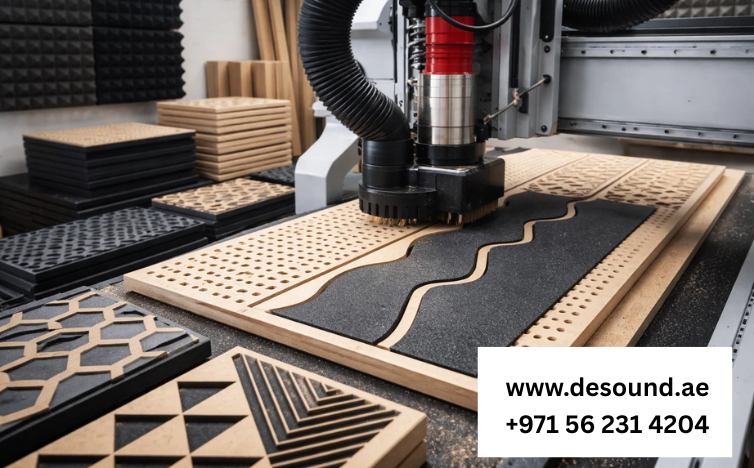
Professional acoustic installations demand far more than simply placing panels on walls or ceilings. Whether it is a recording studio, auditorium, corporate office, or home theater, the effectiveness of an acoustic system depends heavily on precision engineering. Even minor dimensional inaccuracies can compromise sound absorption, diffusion performance, and overall aesthetic integration.
This is where CNC cutting for professional acoustic installations becomes indispensable. Computer Numerical Control (CNC) technology enables exact measurements, intricate patterns, and flawless repetition—qualities that manual cutting methods simply cannot match. In high-performance acoustic environments, precision is not optional; it is foundational.
At Desound, we integrate advanced CNC cutting processes into our acoustic services to ensure that every panel, diffuser, and decorative element aligns perfectly with project specifications.
What Is CNC Cutting and How It Works
CNC cutting uses computer-guided machinery to cut materials such as MDF, plywood, PET felt, gypsum, and composite acoustic boards with extreme accuracy. The process begins with CAD (Computer-Aided Design) software, where detailed acoustic panel layouts and patterns are created. These digital files are then transferred to CNC machines that execute the cuts with micron-level precision.
Unlike manual fabrication, CNC systems:
- Maintain consistent tolerances
- Eliminate human error in repetitive cuts
- Allow complex geometric patterns
- Reduce material waste
For acoustic installations, this level of accuracy ensures that sound-absorbing and diffusing elements perform exactly as designed in acoustic simulations.
Why CNC Cutting Is Critical for Acoustic Panel Performance
Acoustic materials are engineered based on specific surface areas, perforation ratios, groove depths, and panel thicknesses. Even slight deviations can alter their Noise Reduction Coefficient (NRC) or diffusion characteristics.
1. Accurate Perforation Patterns
Perforated acoustic panels rely on precise hole diameters and spacing to control sound absorption frequencies. CNC cutting guarantees uniform perforation density across every panel, ensuring consistent acoustic performance throughout the installation.
2. Perfect Edge Finishing
In professional environments, especially studios and corporate interiors, visible edges must be clean and seamless. CNC machining produces sharp, splinter-free edges that elevate both acoustic and visual quality.
3. Repeatable Results Across Large Projects
Large commercial spaces require hundreds of identical panels. CNC technology ensures each unit is an exact replica of the original design, maintaining uniformity across entire installations.
This consistency is why CNC cutting for professional acoustic installations is considered an industry standard rather than a luxury.
Supporting Custom Acoustic Designs
Modern architectural acoustics increasingly blends performance with aesthetics. Designers demand custom patterns, branded wall panels, 3D diffusers, and decorative acoustic features that integrate seamlessly into interiors.
CNC cutting enables:
- Custom geometric diffusers
- Slotted and grooved wood panels
- Branded acoustic wall designs
- Decorative ceiling baffles
- Complex wave or lattice patterns
At Desound, our CNC cutting services allow architects and designers to transform creative concepts into precisely fabricated acoustic solutions. This combination of acoustic science and visual design would be nearly impossible with manual tools.
Improved Installation Efficiency and Reduced Waste
Time efficiency is a major factor in commercial projects. CNC-fabricated acoustic components arrive on-site pre-cut to exact dimensions, significantly reducing installation time.
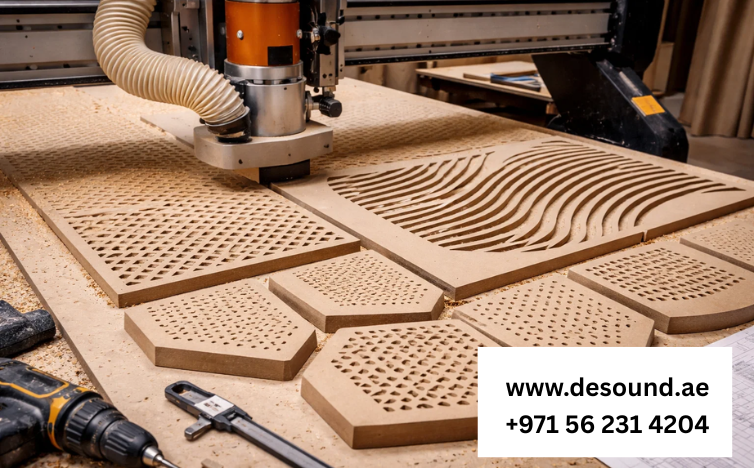
Key advantages include:
- Minimal on-site modifications
- Faster panel alignment
- Lower labor costs
- Reduced material wastage
- Cleaner job sites
Since panels are digitally optimized before cutting, material yield is maximized. This reduces scrap waste and contributes to cost-efficient acoustic installations.
Enhanced Durability and Structural Integrity
CNC cutting does not only improve aesthetics—it enhances structural reliability. Uniform cuts prevent weak edges, uneven grooves, or inconsistent slot depths that could compromise panel integrity.
For example:
- Slatted wood acoustic panels require consistent spacing to maintain strength.
- CNC-cut PET acoustic panels retain structural balance without warping.
- Custom baffles maintain precise weight distribution.
These factors contribute to long-term durability, especially in high-traffic or commercial environments.
Integration with Advanced Acoustic Engineering
Professional acoustic design often involves software modeling to predict reverberation time (RT60), reflection paths, and absorption rates. CNC cutting bridges the gap between acoustic modeling and physical implementation.
Once an acoustic engineer finalizes panel dimensions and layouts, CNC fabrication ensures that the physical product matches the digital acoustic model exactly.
This integration is critical in:
- Recording studios
- Cinemas
- Conference rooms
- Educational institutions
- Performance halls
Without CNC precision, theoretical acoustic calculations may not translate accurately into real-world performance.
Competitive Advantage for Professional Installers
Acoustic contractors who rely on CNC technology deliver higher-quality results with fewer errors. For clients, this means better sound clarity, fewer post-installation adjustments, and superior aesthetic finishing.
At Desound, our acoustic services combine:
- Technical acoustic expertise
- High-precision CNC cutting
- Custom fabrication solutions
- Professional installation support
By offering CNC cutting services tailored specifically for acoustic applications, we ensure that every project meets professional performance standards.
Sustainability and Cost Efficiency
Sustainability is increasingly important in construction and interior projects. CNC cutting contributes to environmentally responsible acoustic installations by:
- Optimizing material layouts
- Reducing excess waste
- Minimizing rework
- Lowering energy use through efficient machining
Because cuts are digitally planned, raw material sheets are used more efficiently compared to manual fabrication. This translates into lower material costs and reduced environmental impact.
Why CNC Cutting Is No Longer Optional
The acoustic industry has evolved significantly over the past decade. Clients expect not only functional sound control but also architectural sophistication. Manual cutting methods cannot consistently meet these demands.
CNC cutting for professional acoustic installations ensures:
- Precision-engineered performance
- Seamless aesthetic integration
- Faster project delivery
- Consistent quality control
- Long-term durability
For high-performance acoustic environments, CNC technology is not an upgrade—it is a necessity.
Call us: Contact DeSound Soundproofing Expert in Dubai For Soundproofing: +971 56 231 4204
Final Thoughts
Professional acoustic installations require a combination of engineering accuracy, design flexibility, and efficient execution. CNC cutting stands at the center of this process, transforming digital acoustic designs into precise, install-ready components.
At Desound, our CNC cutting services are specifically optimized for acoustic applications, enabling us to deliver reliable, custom-engineered sound solutions across commercial and residential projects.