
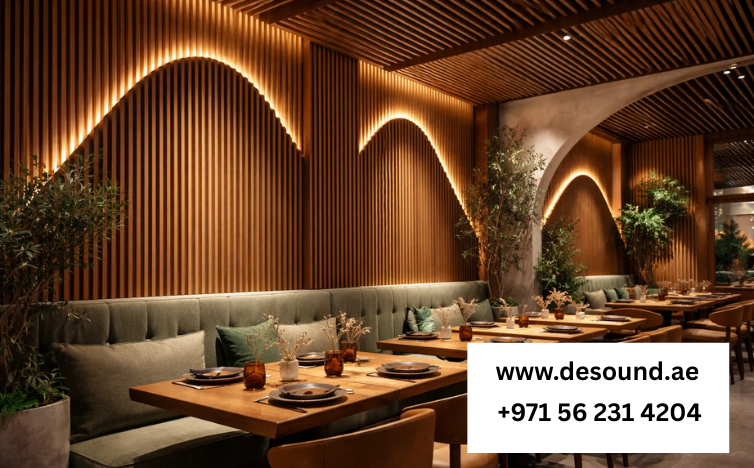
The review that kills a Dubai restaurant’s momentum doesn’t say the food was bad. It says “great food but too noisy — couldn’t have a proper conversation.” Read enough of those and you stop wondering why certain restaurants with genuinely excellent kitchens plateau at three stars on Google while technically inferior competitors with better acoustics pull consistent fours.
Noise is the invisible experience variable that Dubai’s restaurant industry has systematically underinvested in — not from indifference, but because the acoustic treatment conversation has historically been framed around industrial-looking foam products that no serious hospitality designer would specify in a curated interior. The aesthetic compromise felt too large.
Acoustic groove panels change that calculation entirely. They’re the product that finally closes the gap between acoustic performance and interior quality in a way that restaurant designers in Dubai are increasingly willing to work with — and in some cases, actively seeking out.
What Makes Restaurant Acoustics Particularly Difficult
The noise problem in a Dubai restaurant is genuinely complex compared to, say, an office or a studio. In a studio, you can eliminate the noise source. In a restaurant, the noise source is the service itself — conversation, movement, music, kitchen activity, the particular social energy of a busy dining room. You’re not trying to eliminate sound. You’re trying to control its behaviour so it stays at a level and character that enhances rather than overwhelms the experience.
Dubai’s restaurant interiors compound this challenge through the same aesthetic choices that make them visually distinctive. Polished concrete, marble, terrazzo, exposed brick, large-format tile — surfaces that photograph beautifully and feel premium to the touch are acoustically reflective by nature. They bounce sound rather than absorbing it. In a restaurant running at 70% capacity with ambient music, twenty simultaneous conversations, and the percussion of cutlery on hard surfaces, these reflective materials create reverberation times that can push above 1.5 seconds. That’s the level where conversations at adjacent tables start bleeding into each other, where the ambient noise floor rises high enough that diners unconsciously raise their voices, which raises the floor further, which triggers more voice raising in a cycle that ends with a room that feels chaotic regardless of how good everything else is.
The acoustic treatment target for a Dubai restaurant is reverberation time between 0.8 and 1.2 seconds — lively enough to feel social and energetic, controlled enough that conversation stays at the table where it belongs.
Why Groove Panels Specifically — Not Just Any Acoustic Panel
The acoustic treatment options for restaurant interiors have historically created a binary that designers found genuinely difficult. On one side: foam panels, which are highly effective acoustically and visually unacceptable in any serious hospitality interior. On the other: standard fabric-covered panels, which are more designerly but visually announce themselves as “acoustic treatment” rather than reading as an interior material choice.
Acoustic groove panels resolve this by working with the visual language of premium timber surfaces — the same material register that restaurant interiors already use extensively for warmth, texture, and hospitality character. The panel surface features precisely machined parallel grooves across a timber or wood-composite face, with the grooves and the absorptive backing material working together to achieve acoustic absorption. The visual result reads as architectural millwork — a considered timber surface feature — rather than as applied acoustic treatment.
De Sound’s acoustic groove panels at AED 150 per square metre bring this resolution to the Dubai market at a price point that works within serious restaurant fit-out budgets. The groove pattern creates visual depth and shadow play that changes character depending on lighting direction — which in a hospitality interior where lighting design is already doing sophisticated work, means the panels actively contribute to the evening atmosphere rather than sitting inert on the wall.
How the Acoustic Performance Actually Works
The groove panel’s acoustic mechanism involves both the surface geometry and the absorptive layer behind it, and understanding both explains why the combination achieves performance that a flat timber panel of identical dimensions would not.
Sound waves striking the grooved surface encounter a more complex geometry than a flat wall. The groove edges create diffraction — the bending of sound waves around the groove profile — which redirects some energy away from the direct reflection path and into the groove valleys. Within the groove valleys, the absorptive backing material is directly exposed to sound energy and converts it to negligible heat through viscous resistance in its porous structure.
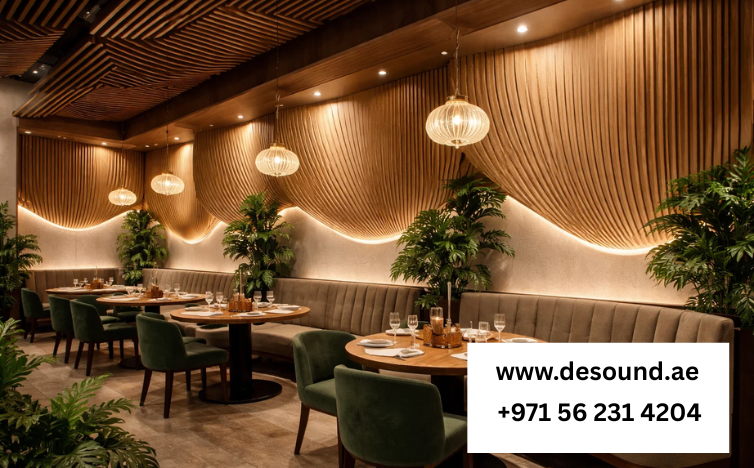
The result is an NRC (Noise Reduction Coefficient) performance that depends on groove width, groove depth, groove spacing, and backing material specification — but that consistently outperforms an equivalent flat timber surface by a factor that makes meaningful acoustic difference in restaurant environments. The groove geometry effectively increases the acoustic surface area beyond the physical panel area, which is why panels that look like a continuous timber surface perform substantially better acoustically than continuous timber would.
For Dubai restaurant interiors, a coverage area of 20 to 35% of the total wall surface area with acoustic groove panels typically reduces reverberation time by 0.4 to 0.7 seconds from an untreated baseline — bringing most standard Dubai restaurant spaces into the target 0.8 to 1.2 second range without over-treating the space into acoustic deadness.
The Design Integration Argument — Why This Matters for Dubai’s Hospitality Market
Dubai’s restaurant design culture is among the most sophisticated in the world. The city’s F&B market attracts international designers, Michelin-starred concepts, and global hospitality brands who bring rigorous design standards and specific interior languages to their Dubai fit-outs. The acoustic treatment specified in these spaces needs to meet the same standard.
Acoustic groove panels work within multiple interior design languages that are prominent in Dubai’s current restaurant scene. In Japandi-influenced interiors — the minimal, warm, timber-forward aesthetic that a significant number of Dubai’s newer openings are working in — groove panels are virtually indistinguishable from decorative timber slat features that would be specified regardless of acoustic considerations. The acoustic function is hidden within the visual logic of the design.
In darker, more atmospheric hospitality interiors — the moody, candlelit dining rooms that JBR, DIFC, and Downtown Dubai’s premium restaurant clusters favour — groove panels in darker timber finishes or dark-stained profiles absorb light alongside sound, contributing to the low-reflectivity character that makes these spaces feel intimate. The acoustic and atmospheric functions align rather than competing.
For restaurant designers in Dubai who have historically felt they had to choose between acoustic performance and interior quality, groove panels are the product that removes that trade-off. The specification meeting doesn’t involve convincing a client to accept something that looks like acoustic treatment. It involves showing them a material they’d want in the space for aesthetic reasons alone — that also solves the noise problem.
Where in the Restaurant the Panels Go — and Why Placement Matters
Covering every wall with acoustic groove panels is neither necessary nor desirable. The aesthetic goal is treated surfaces that feel intentional, not a room that has been uniformly panelled without visual hierarchy. The acoustic goal is sufficient coverage on the right surfaces to reach the target reverberation time. These goals align toward strategic placement rather than total coverage.
The rear wall of the restaurant — the wall that faces the majority of diners and is the primary reflection surface for conversation energy generated across the room — is the highest-impact single surface. A full-height groove panel installation on the rear wall addresses the dominant reflection path while creating a feature surface that anchors the room’s visual composition. This is where the panels earn the most acoustic work per square metre while also doing the most design work.
Side walls — particularly in long, narrow restaurant formats common in Dubai’s mall-adjacent and street-level retail units — are the secondary priority. Sound bounces between parallel side walls in these geometries, creating flutter echo that makes voices sound strained and effortful. Treating one or both side walls, even partially, breaks this flutter path and significantly reduces the cumulative noise buildup that comes from it.
Ceilings in high-volume restaurant spaces — the converted industrial formats, the double-height dining rooms, the open-ceiling warehouse aesthetics — benefit from groove panels or ceiling baffles working in combination. A groove panel feature on the rear wall combined with acoustic baffles in the ceiling volume of a tall restaurant space addresses both the primary wall reflection and the extended reverberation from the ceiling height simultaneously.
The Revenue Case — Because Design Aesthetics Aren’t Enough
Beautiful interiors justify the acoustic treatment investment on design grounds alone in many cases. But the commercial case adds weight that makes the specification decision easier for restaurant operators managing tight fit-out budgets.
Research consistently confirms that dining duration and spend correlate negatively with perceived noise. A 2016 study published in the Journal of the Academy of Marketing Science found that high ambient noise levels decrease the time diners choose to stay at the table and reduce secondary ordering — drinks, desserts, coffees — that constitute a significant proportion of restaurant margin. Diners who feel comfortable staying longer spend more. Diners who feel acoustically stressed leave as soon as the meal obligation is complete.
In Dubai’s competitive restaurant market where average main course prices range from AED 80 to AED 300 and secondary ordering can represent 30 to 50% of total check value, the revenue difference between a dining room at 1.0 seconds reverberation time and one at 1.8 seconds reverberation time is not hypothetical — it shows up in per-cover averages and review scores within weeks of the acoustic improvement being installed.
De Sound’s acoustic groove panels at AED 150 per square metre make this investment accessible. A 50-square-metre treatment covering the key reflective surfaces in a mid-size Dubai restaurant — rear wall, partial side wall treatment — costs approximately AED 7,500 in materials before installation. Against the revenue recovery that a noticeably quieter dining room produces within a single month of peak operation, the arithmetic is straightforward.
Call us: Contact DeSound Soundproofing Expert in Dubai For Soundproofing: +971 56 231 4204
The Conversation Worth Having Before the Next Menu Update
Most Dubai restaurant operators invest in menu evolution, staff training, marketing, and photography as the primary drivers of performance improvement. These all matter. None of them addresses the acoustic environment that shapes how every dining experience actually feels to the person having it.
The groove panel specification conversation takes one meeting with a supplier who understands both the acoustic and the design dimensions of the product. The installation disrupts operations for one to two days depending on the coverage area and the complexity of the wall surfaces. The result is permanent — a dining room that sounds as good as it looks, that produces the reviews that reflect the actual quality of the food and service, and that retains the diners who would otherwise have eaten once and not returned.