

Silence in Oman has a particular quality that people who live there recognise immediately — the kind of deep, undisturbed quiet that defines the country’s natural landscape, from the Hajar Mountains to the Empty Quarter’s edges. It’s part of what makes the country genuinely liveable in a way that more chaotic regional cities sometimes aren’t.
Which is why it’s particularly jarring when that quality of quiet fails to exist inside the buildings where Omanis work and live every day.
Muscat’s expanding commercial districts — Al Khuwair, Ghubra, Ruwi, the newer developments along Way 46 — are generating the kind of ambient noise profiles that follow every fast-growing urban economy. Traffic on the Sultan Qaboos Highway doesn’t stop. Construction adjacent to established residential areas in Bawshar, Madinat Al Sultan Qaboos, and Qurum runs on its own schedule. And inside Oman’s growing commercial office stock, the same open-plan noise problems that plague every modern office market are playing out — just with less attention paid to solving them, because the acoustic treatment industry in Oman is earlier in its development than in Dubai or Abu Dhabi.
That’s the gap this article addresses. Oman has the same noise problems as the rest of the region. The solutions are the same. And they’re more available than most Oman-based businesses and homeowners currently realise.
Why Oman’s Building Stock Creates Specific Acoustic Challenges
Omani residential construction has its own character — and from an acoustic standpoint, it creates predictable challenges worth understanding before specifying any treatment.
Traditional and semi-traditional Omani villa construction uses thick masonry walls that perform reasonably well for airborne sound blocking between the interior and the exterior. The mass is there. What’s often missing is the sealing — windows that fit loosely in frames, door gaps that haven’t been addressed acoustically, and HVAC systems installed without acoustic consideration. The wall does its job. The gaps around everything else undo it. In Muscat’s coastal areas where the sea breeze encourages keeping windows open during cooler months, this becomes a seasonal noise infiltration problem that acoustic window sealing and door seal systems address directly.
Commercial offices in Oman — particularly in the older business districts of Ruwi and Muttrah, and in the free zone developments around Sohar and Salalah — tend toward a building stock similar to Sharjah’s: concrete block construction, lightweight internal partitions, minimal acoustic consideration in the original design. The same structural characteristics that make these spaces affordable and flexible for tenants make them acoustically problematic. Shared walls between tenanted units, HVAC ductwork running between spaces, and hard floor and ceiling surfaces throughout create the reverberant, noise-transmissive environments that make concentrated office work frustratingly difficult.
Homes: The Three Problems That Matter Most
Residential soundproofing in Oman breaks down into three distinct problems that appear consistently across different property types and locations.
The first is road traffic penetration — and in Muscat specifically, the Sultan Qaboos Highway and its major arterials generate noise levels that reach deep into adjacent residential neighbourhoods. Homes in Al Khuwair, Shatti Al Qurum, and Madinat Al Sultan Qaboos within 300 to 500 metres of major roads consistently report traffic noise as the primary quality-of-life complaint. The solution is acoustic laminated glass windows — multi-layer glass units with a PVB acoustic interlayer that can reduce traffic noise by up to 35 to 40 decibels — combined with proper window frame sealing to eliminate the gap transmission that undermines even high-performance glass. A well-sealed acoustic window system transforms a bedroom facing a main road from a sleep-disrupting environment into a genuinely restful one.
The second problem is neighbour noise in apartment and villa compound settings. Oman’s residential development pattern includes a significant stock of apartment buildings and gated villa compounds where properties share walls, floors, and ceilings. Impact noise from upstairs neighbours — footsteps, furniture movement, children playing — is the most common specific complaint, followed by airborne sound from adjacent units. Acoustic floor underlay installed beneath floor finishes addresses impact transmission, while Mass Loaded Vinyl applied to shared walls adds blocking mass that standard partition construction lacks. For apartments in Muscat where tenants cannot structurally modify the building, both of these are non-invasive retrofit solutions that require no landlord permission beyond standard fitting.
The third is HVAC noise — underappreciated as a domestic noise problem but consistently present in Omani homes that run air conditioning heavily through the long summer months. Ducted split systems generate both the mechanical noise of the unit itself and the duct-borne transmission of external sound that enters through the outdoor unit location. Acoustic lining within ductwork and proper vibration isolation for AC units are specialised interventions, but for homeowners where everything else has been addressed and a persistent low-frequency hum remains, HVAC is almost certainly the remaining culprit.
Offices: Where Productivity Disappears Into the Noise
The research on office noise and productivity is consistent enough to have entered mainstream business awareness. A 2019 Oxford Economics study found that employee performance drops measurably when noise exceeds 65 decibels in working environments — and most open-plan Omani offices in commercial buildings reach and exceed that level during normal working hours without any active noise sources beyond conversation and typical office equipment.
What makes this particularly relevant for Oman’s growing private sector is the shift toward knowledge-intensive work — consulting, financial services, technology, engineering — where the cognitive tasks people are performing are specifically the ones most vulnerable to noise distraction. A logistics company managing physical shipments can tolerate a noisier environment more than a law firm drafting contracts or an engineering consultancy reviewing technical specifications. As Oman’s economic diversification continues pushing businesses toward higher-value services, the acoustic quality of those businesses’ working environments becomes more consequential.
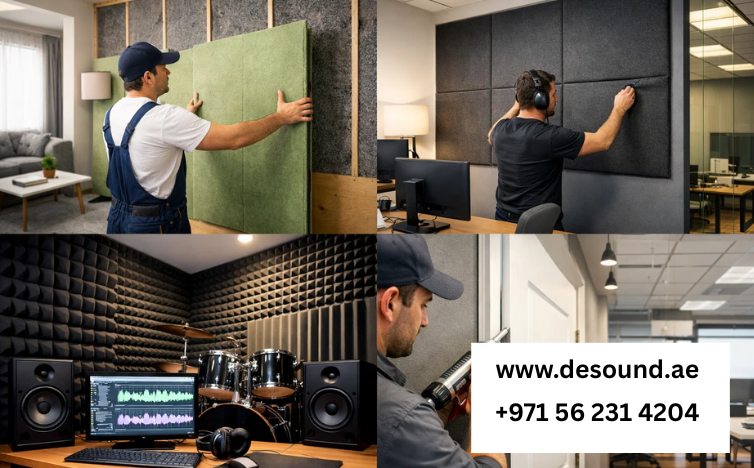
The treatment stack for a typical Omani commercial office follows the same logic as everywhere else in the region: acoustic panels — PET or stretch fabric — for internal reverberation control in open-plan areas, MLV for wall mass enhancement between tenanted spaces, acoustic glass for glazed partitions and conference room fronts, acoustic doors and door seals for enclosed rooms requiring conversation privacy, and ceiling baffles for high-volume spaces. The specific combination depends on the building type, the primary noise complaint, and the budget available — which is exactly the kind of assessment that De Sound’s consultation process addresses before any product is specified.
Conference Rooms and Meeting Spaces — Oman’s Most Underserved Need
If there’s one specific space type in Oman’s commercial sector that is consistently inadequately treated for acoustics, it’s the conference room. This observation applies across government ministries in Muscat, private sector offices in Al Khuwair, and commercial operations in Sohar and Salalah free zones equally.
The standard Omani conference room has a thin plasterboard partition, a standard hollow-core or lightweight flush door, a tiled or hard floor, and a standard suspended ceiling grid with basic mineral fibre tiles. It was not designed to contain sound. It was designed to contain people. The acoustic difference is significant — in a space built this way, conversations are intelligible through the wall from the corridor, video call audio sounds echoey and unprofessional, and confidential discussions are only private in the sense that people are physically separated, not acoustically.
Fixing this is not architecturally complex. Acoustic panels on interior walls control reverb and improve the clarity of speech within the room. MLV on the shared walls with adjacent spaces adds the blocking mass the original partition lacks. An acoustic door with perimeter sealing closes the transmission path that the standard door leaves wide open. Acoustic ceiling tiles replace the standard grid tiles with higher-performance alternatives that contribute meaningfully to both internal absorption and ceiling transmission loss. Together, these interventions transform the conference room from a broadcasting facility into a genuinely private, acoustically functional meeting space — without structural construction and within timelines that don’t disrupt ongoing business operations.
What Oman-Specific Specification Means in Practice
Specifying acoustic treatment for Oman is not identical to specifying for Dubai — and it shouldn’t be. The differences matter for performance and longevity.
Salalah’s Khareef humidity has been mentioned. Muscat’s coastal location means ambient humidity is higher than inland UAE locations through much of the year, with summer peaks that rival the Gulf’s most challenging conditions. Acoustic materials with open-face natural fibre construction that perform well in drier environments can absorb moisture, degrade, and eventually support mold growth if specified without accounting for Oman’s coastal humidity profile. PET panels — fully synthetic, non-hygroscopic, washable, and mold-resistant — outperform natural fibre alternatives in Oman’s coastal climate and should be specified as the default wall panel choice in humidity-exposed installations.
Dust is the other environmental factor. Oman experiences significant dust events, particularly in northern and interior regions, and fine particulate accumulation in open-face acoustic panels creates two problems: progressive performance degradation as particulate fills the absorptive pores, and hygiene concerns in occupied spaces where people spend extended periods. Sealed-face acoustic products — panels with fabric facing that prevents direct dust penetration to the absorptive core — are the appropriate specification for Oman’s dusty environment.
De Sound’s product and service reach covers Oman alongside the UAE market, which means Oman-based businesses and homeowners have access to the same specification expertise and product quality that serves the UAE’s more acoustically mature market — without the coordination complexity of working with suppliers unfamiliar with regional conditions. For anyone in Oman currently tolerating noise that shouldn’t be there, that access point is closer than it probably appears.
Call us: Contact DeSound Soundproofing Expert in Oman For Soundproofing: +971 56 231 4204
The Starting Point That Costs Nothing
Every soundproofing project — residential or commercial, in Muscat or Salalah or Sohar — starts with the same zero-cost step: identifying what’s actually causing the noise problem and where the primary transmission paths are.
The reason this matters is that spending on the wrong solution wastes money without solving the problem. A home that installs acoustic window glass when the primary noise path is a poorly sealed front door will be disappointed. An office that covers walls in absorption panels when the real issue is noise bleeding through a shared lightweight partition needs mass, not absorption. The diagnosis determines the specification, and getting the diagnosis right is what separates an acoustic treatment that works from one that looks like treatment while the noise continues unabated.