
Walk into almost any growing business in Sharjah’s industrial or commercial districts and ask the manager what their biggest operational frustration is. Nine times out of ten, it won’t be rent or staff or logistics. It’ll be some version of: “We can’t hear ourselves think.”
Sharjah’s commercial sector has expanded aggressively over the past decade. The industrial areas — Industrial Area 1 through 18, the free zones along Emirates Road, the newer business parks in Al Qasimia and Al Nahda — are packed with businesses that outgrew their original spaces and moved into larger premises without ever budgeting for acoustic infrastructure. Open-plan offices where sales teams shout over each other. Shared conference rooms with walls thin enough to hear everything next door. Warehouses converted into offices where sound bounces off metal sheeting and poured concrete for what feels like an eternity.
The noise problem in Sharjah offices is real, it’s widespread, and unlike most operational problems, it has direct, proven, affordable solutions. Here’s exactly what works and why.
Why Sharjah’s Office Noise Problem Has Its Own Character
Sharjah’s commercial building stock is different from Dubai’s in ways that matter acoustically. A significant portion of Sharjah’s offices occupy converted industrial spaces, older commercial buildings from the 1990s and early 2000s, and low-rise multi-tenanted units in free zone developments. These buildings were designed for storage, light manufacturing, or basic commercial use — not for environments where dozens of people need to concentrate, communicate clearly, or hold confidential conversations.
Concrete block construction with minimal internal partition mass, shared HVAC systems that channel sound between units through ductwork, lightweight gypsum partitions between tenanted spaces, and hard floor surfaces throughout — this is the acoustic profile of the typical Sharjah office building. Add the dense tenancy common in Sharjah’s free zones, where businesses operate in close quarters, and you get a noise environment that genuinely undermines how people work.
The consequences are measurable. A 2021 study published in the Journal of Environmental Psychology confirmed that sustained workplace noise above 65 decibels reduces cognitive task performance by up to 40% and increases error rates significantly. In a Sharjah trading company, logistics operation, or professional services firm where accuracy and concentration matter daily, that performance degradation has a direct financial cost — one that consistently exceeds what proper acoustic treatment would have cost.
The Soundproofing Toolkit — What Each Product Actually Does in an Office Context
The best soundproofing solution for any specific Sharjah office is not a single product. It’s a combination of products addressing different transmission paths simultaneously. Understanding what each element does makes the decision rational rather than guesswork.
Mass Loaded Vinyl (MLV) is the workhorse of commercial soundproofing where structural work isn’t possible. MLV is a dense, flexible barrier material that adds significant blocking mass to existing walls, ceilings, and floors without requiring construction. In Sharjah’s leased offices — where tenants cannot structurally modify the building — MLV applied to existing partition walls measurably reduces airborne sound transmission between spaces. It’s not glamorous, and it’s typically hidden behind a finished surface, but it’s the product that makes thin partition walls perform like substantially heavier construction. For businesses in Sharjah’s shared commercial buildings dealing with sound bleed from neighbouring tenants, MLV is often the highest-impact single investment available.
Acoustic panels — PET, wood wool and stretch fabric variants — address the internal acoustic problem rather than the transmission problem. An open-plan Sharjah office with hard walls, tile floors, and a suspended grid ceiling is a highly reverberant environment. Voices carry across the entire floor. Phone conversations are audible from six desks away. The ambient noise floor builds as more people work simultaneously, and everyone gradually raises their voice to compensate — which makes the problem worse in a self-reinforcing cycle.
PET acoustic panels mounted on walls or suspended as ceiling baffles break this cycle by converting sound energy into negligible heat rather than reflecting it back into the space. A well-treated open-plan office reduces its measured reverberation time from 1.5 to 2.0 seconds down to 0.5 to 0.8 seconds — and the perceptual difference in how noise levels feel in that space is dramatic. This is what employees describe as a room that “feels quieter” even before noise levels are formally measured. The sound is still there; it simply isn’t bouncing back and compounding.
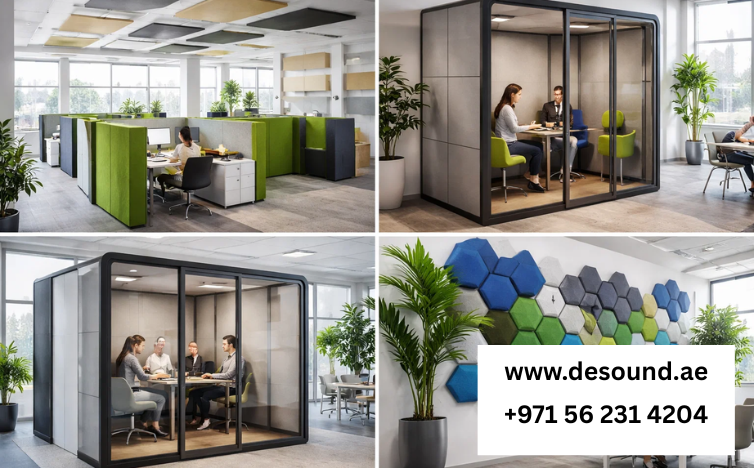
Acoustic laminated glass solves the specific and significant problem of glazed partitions — conference room walls, management office fronts, and reception dividers built from standard glass. Standard glass is acoustically poor. Sound passes through it with minimal resistance, and the glass panels vibrate sympathetically at certain frequencies, amplifying rather than blocking transmission. Acoustic laminated glass with a PVB interlayer achieves STC ratings of 38 to 45, turning what was a nearly transparent acoustic barrier into a proper partition. For Sharjah businesses that invested in glass-fronted offices for visual openness, acoustic glass is the intervention that lets them keep the aesthetic while gaining the privacy they need.
Acoustic doors and door seals are where most soundproofing installations fail quietly. A wall system can achieve excellent acoustic performance, but if the door in that wall has a 5mm gap at the threshold and no perimeter seal, the entire system’s performance is compromised through that gap. Sound obeys the path of least resistance. A sealed wall with an unsealed door is an acoustic sieve. For Sharjah conference rooms, HR offices, and management spaces where conversation privacy matters, acoustic door seals and proper acoustic door specification are the completions that make everything else work. The cost is minimal relative to the wall treatment; the impact on final performance is disproportionately large.
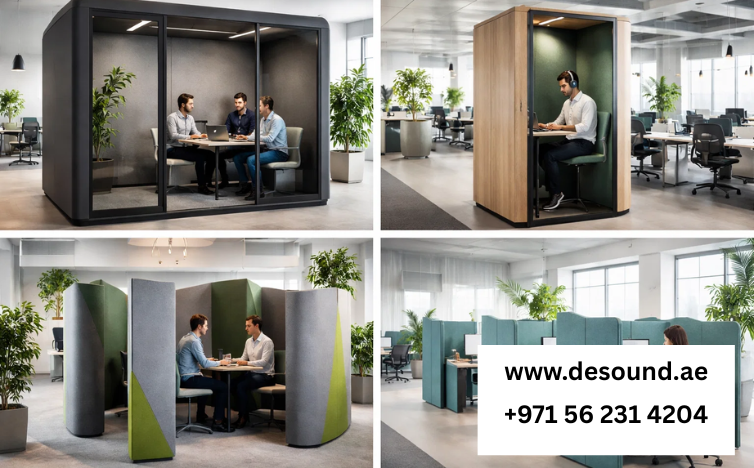
Acoustic pods represent a fundamentally different approach to office privacy that’s increasingly relevant to Sharjah’s growing startup and SME community. Rather than treating the entire office to achieve uniform acoustic quality — which is expensive and requires comprehensive planning — freestanding acoustic pods create isolated, treated environments within the existing space. A pod positioned in an open-plan Sharjah office provides a private, quiet call booth or focus space without any construction, without any landlord permissions, and without any permanent modification to the building. For businesses in short-term leases or rapidly scaling environments where flexibility matters as much as acoustic quality, pods offer genuine value that fixed treatment can’t match.
The Conference Room Problem Sharjah Businesses Know Well
Conference rooms deserve specific attention because they concentrate every acoustic failure mode in one space simultaneously.
The typical Sharjah office conference room has a rectangular hard-surfaced enclosure with a table, chairs, and minimal soft furnishings. It usually shares at least one wall with the main office floor and another with a corridor. The door is standard commercial hollow-core — acoustically almost worthless. The suspended ceiling tiles are standard mineral fibre — better than nothing, but insufficient for proper isolation. And the air conditioning duct that serves the conference room almost certainly also serves adjacent spaces, providing a direct sound transmission path through the ductwork regardless of what the walls do.
The consequence is predictable and familiar: conversations in the conference room are audible in the corridor and adjacent spaces, the room has a slight echo quality that makes voice recordings on video calls sound unprofessional, and there’s a persistent low hum from the HVAC that becomes more noticeable during quiet moments in a meeting.
Addressing this properly requires layering: acoustic wall panels or stretch fabric treatment on the interior walls to control internal reverb, MLV on the shared wall with the main office to reduce bleed, acoustic door replacement or heavy-duty perimeter sealing, and either acoustic ceiling tiles in the suspended grid or baffles below it for ceiling treatment. That combination transforms a conference room that functions as a broadcasting centre into one that actually contains conversations.
De Sound’s product range covers every component of this layered approach, and their Sharjah-area service capability means the specification and installation can be handled regionally rather than coordinating cross-emirate logistics — which matters when scheduling around active business operations.
Floor Noise — The Transmission Path Sharjah Offices Consistently Miss
In Sharjah’s multi-storey commercial buildings, floor-to-ceiling sound transmission is often more disruptive than wall-to-wall transmission — and it’s routinely overlooked in acoustic planning.
Impact noise from the floor above — footsteps, chair movements, dropped objects — travels directly through the concrete slab and radiates into the ceiling of the space below with minimal natural attenuation. In concrete block construction typical of Sharjah’s commercial stock, this impact transmission is particularly efficient. Offices on lower floors of busy multi-tenanted buildings regularly report ceiling-transmitted impact noise as a significant distraction throughout the working day.
Acoustic floor underlay — installed beneath carpet, timber, or tile flooring — decouples the floor surface from the structural slab, interrupting the impact energy transmission path. Acoustic floating floor systems take this further, using resilient isolator pads to fully decouple the floor structure. For Sharjah businesses in tenanted buildings where both good neighbourliness and self-protection from above matter, floor acoustic treatment is one of the most cost-effective investments available — and one of the least commonly implemented, which means it remains a genuine competitive differentiator for offices that get it right.
The Specification Question That Determines Real Results
Products matter. Specification matters more. A Sharjah office that installs acoustic wall panels without measuring the existing reverberation time, without identifying the primary noise transmission paths, and without understanding the frequency content of the specific noise problem may spend significant budget and still not solve the problem that was causing the most disruption.
What does this mean practically? Before committing to any soundproofing investment, a proper assessment should identify whether the primary issue is internal reverberation (an absorption and treatment problem), airborne transmission between spaces (a mass and sealing problem), impact transmission through the structure (a decoupling and underlayer problem), or some combination of all three. Each of these has different product solutions, different installation approaches, and different performance expectations.
The offices that achieve genuinely quiet, productive environments are the ones that start with diagnosis and work methodically to the specification. The ones that buy panels and put them up without that groundwork often end up in the frustrating position of having treated a space that still sounds wrong — because they treated the visible symptoms rather than the actual transmission paths.
For Sharjah offices serious about solving this properly, the starting point is a consultation with acoustic specialists who understand both the product range and the specific building typologies common in the emirate. Get the specification right first. The installation follows naturally from there, and so do the results.
Call us: Contact DeSound Soundproofing Expert in Sharjah For Soundproofing: +971 56 231 4204
What Productive Silence Is Actually Worth to a Sharjah Business
The ROI conversation for office soundproofing rarely gets made explicitly, which is part of why it stays underfunded. So here it is plainly.
Research by Steelcase — one of the world’s largest workplace research organisations — found that employees in noisy, acoustically uncontrolled office environments lose an average of 86 minutes of productive work time per day to noise-related distraction and recovery. In a Sharjah office of 20 staff, that’s 1,720 minutes of lost productivity daily. At any reasonable labour cost, the monthly value of recovering even a third of that dwarfs any acoustic treatment investment in the space.
That’s before accounting for staff retention — acoustic discomfort consistently ranks as a top workplace dissatisfaction driver — and client perception. A Sharjah business that holds client meetings in a conference room where every conversation leaks to the corridor, or pitches investors on a video call from an echoey open-plan office, is communicating something about operational standards that no amount of marketing can offset.