
Acoustic challenges in apartment buildings are becoming more common as urban living continues to grow. Residents often face issues like footstep noise, furniture movement, airborne sound, and vibration transfer from adjacent units. This is where modern soundproofing systems—especially acoustic floating floors—play a critical role. Many homeowners and building managers now explore How Acoustic Floating Floors Reduce Noise in Apartments to create peaceful living environments supported by professional providers like DeSound.
Understanding What Makes an Acoustic Floating Floor Different
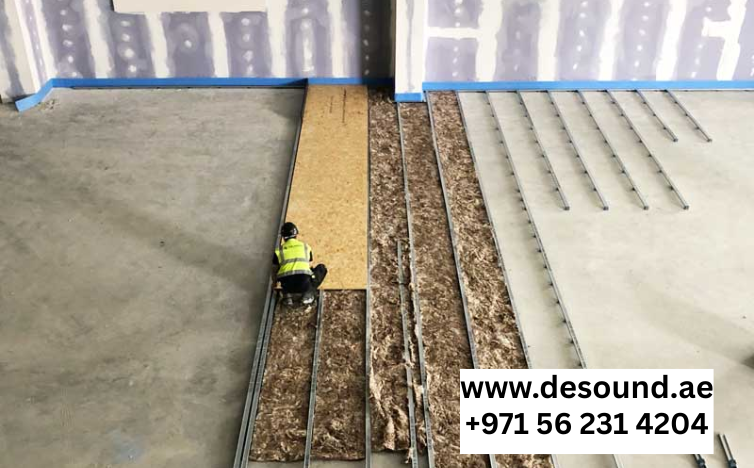
An acoustic floating floor is a specialized flooring system designed to minimize sound transfer between spaces. Unlike standard flooring, it does not sit directly on the structural slab. Instead, it is installed over a resilient layer that “floats” the floor, breaking the direct connection between surfaces.
This structure significantly reduces impact noise, which is one of the biggest sources of disturbance in multi-level apartments. By combining mass, decoupling, and damping, floating floors address the core physics of sound transmission—making the system far more effective than simple surface treatments.

How Floating Floors Reduce Impact Noise
Impact noise occurs when footsteps, dropped items, or moving furniture generate shockwaves that travel through the building structure. Traditional flooring materials like tiles or wooden planks do little to stop these vibrations.
Floating floors, however, add a specialized cushioning layer that absorbs and disperses these vibrations before they reach the slab. This helps achieve the main goal explored in the topic How Acoustic Floating Floors Reduce Noise in Apartments, ensuring upper-level activities do not disturb the units below.
Minimizing Airborne Sound Between Units
Airborne sound—such as loud conversations, TV sound, or music—also finds its way through floors, especially when the structural slab is thin. Acoustic floating floors increase the overall mass and density of the flooring system, making it harder for airborne noise to pass through.
The resilient underlay creates an additional barrier, disrupting the energy path of sound waves. This multi-layered approach is particularly valuable in older apartment buildings where conventional flooring systems fail to meet modern acoustic expectations.
Vibration Isolation for Sensitive Areas
Vibration transfer is another often-overlooked issue. Apartments located near gyms, mechanical rooms, roads, or elevators are more exposed to low-frequency vibrations. Floating floor systems are engineered to isolate these vibrations and prevent them from traveling into living spaces.
For residents seeking solutions tailored to How Acoustic Floating Floors Reduce Noise in Apartments, vibration control becomes a key reason to choose this system, especially in high-density residential developments.
Why Apartments Benefit Most From Floating Floor Systems
Apartments inherently share walls, ceilings, and floors, making them prone to noise disturbances. Acoustic floating floors provide a long-term, structural solution that addresses the root cause of noise transfer rather than just masking it.
Unlike carpets, rugs, or surface panels, floating floors offer consistent noise control that does not wear out or lose efficiency over time. This is why developers, landlords, and tenants often rely on established providers like DeSound for installation.
Common Materials Used in Floating Floor Construction
Floating floor performance depends largely on the materials used. The most effective systems include:
- Rubber underlays for strong impact resistance
- Cork or recycled foam layers for sustainable acoustic dampening
- Gypsum or cement board layers to add mass and balance the floor
- High-density acoustic mats for vibration control
A properly layered system ensures durability, stability, and long-term sound isolation.
Installation Process and Professional Approach
Installing acoustic floating floors requires precision and technical knowledge. The process typically includes:
- Preparing the existing floor surface
- Laying the resilient acoustic underlayment
- Installing separation edges to avoid sound bridges
- Adding mass layers or boards
- Applying the final floor finish
Working with specialists such as DeSound ensures correct installation, optimal performance, and compliance with acoustic standards.
Why Choose DeSound for Apartment Noise Control
DeSound delivers professionally engineered acoustic solutions tailored for residential environments. Their expertise ensures that the principles behind How Acoustic Floating Floors Reduce Noise in Apartments are applied accurately and effectively.
From material selection to full installation, DeSound provides reliable, service-focused support for homeowners, developers, and interior contractors.
Call us: Contact DeSound Soundproofing Expert in UAE For Soundproofing: +971 56 231 4204
Conclusion
Acoustic floating floors are one of the most effective and long-lasting ways to reduce noise in apartments. They address impact noise, airborne sound, and vibration transfer by using advanced construction layers that separate the finished floor from the structural slab.
For residents and property developers seeking durable noise reduction, understanding How Acoustic Floating Floors Reduce Noise in Apartments provides a clear path to achieving quiet, comfortable living. With experienced providers like DeSound, these solutions are accessible, efficient, and tailored to modern residential needs.